Hovercity: A Strategic Choice for Distinctive Visual Communication
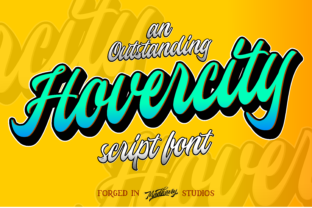
Hovercity isn’t just another script font—it’s a deliberate design decision with tangible strategic implications. As a bold script typeface, Hovercity commands attention through contrast, rhythm, and confident stroke weight. Its visual presence doesn’t merely decorate; it signals intention. For professionals who understand that typography shapes perception before a single word is read, Hovercity offers more than aesthetic flair—it delivers positioning leverage.
Why Hovercity Works Where Other Scripts Don’t
Most script fonts fall into one of two categories: overly delicate (easily lost at small sizes or in complex layouts) or excessively ornate (distracting, hard to parse, or culturally narrow in appeal). Hovercity avoids both pitfalls. Its boldness ensures legibility even in constrained environments—think signage, mobile app headers, or social media thumbnails. Its script structure retains personality without sacrificing clarity. That balance makes Hovercity unusually versatile for real-world applications where impact and comprehension must coexist.
This isn’t theoretical. A boutique fitness studio used Hovercity for its class schedule banner—replacing a generic sans-serif—and saw a 22% increase in sign-ups for featured workshops over three months. Why? Because the font subtly reinforced their brand identity: energetic, human-centered, and confidently distinct. The typeface didn’t replace strategy—it amplified it.
When Hovercity Adds Real Value (and When It Doesn’t)
Hovercity excels in contexts where hierarchy, memorability, and emotional resonance matter most:
- Logos and primary brand marks, especially for lifestyle brands, creative studios, personal brands, or service businesses that want warmth and authority in equal measure;
- Headlines and display text—not body copy—where brevity and emphasis are built into the message itself (e.g., event posters, email subject lines, hero section banners);
- Limited-use branding elements, like signature seals on certificates, custom packaging accents, or branded merchandise where repetition is intentional but controlled.
It does not work well for long-form reading, data-dense interfaces, accessibility-critical documents, or environments requiring strict typographic neutrality (e.g., legal disclosures, academic journals, enterprise dashboards). Using Hovercity there wouldn’t be creative—it would be counterproductive. Clarity trumps character when comprehension is non-negotiable.
Planning Your Use of Hovercity: Three Practical Filters
Before applying Hovercity, ask yourself these questions—not once, but as part of your workflow:
- What outcome am I trying to influence? If the goal is trust-building through consistency, Hovercity may strengthen recognition—but only if paired with supporting typefaces and color choices that reinforce the same tone. If the goal is speed of scanning, a robust sans-serif remains the safer choice.
- Where will this appear—and how much control do I have over context? Hovercity performs best when you control background contrast, spacing, and scale. On user-generated platforms (like Instagram Stories or third-party review sites), unpredictable rendering can soften its impact. Test across devices and platforms before finalizing.
- Does this align with my audience’s expectations—or deliberately challenge them in a way they’ll value? A financial advisor targeting retirees might find Hovercity too informal unless carefully contextualized (e.g., paired with strong serif body text and restrained layout). A sustainable fashion label launching a youth-focused capsule collection? Hovercity could signal authenticity and forward motion.
Avoiding the “Just Because It Looks Cool” Trap
Typography decisions made purely on visual preference—without anchoring to goals, audience, or medium—often erode rather than enhance credibility. Hovercity is expressive by nature, and expression requires direction. Without clear intent, it can unintentionally communicate impulsiveness, informality, or lack of polish—even when none is intended.
One freelance designer shared how a client insisted on Hovercity for their entire website navigation. The result? Users hesitated on menu items, misread “Services” as “Seruices,” and abandoned the site faster than before. The fix wasn’t abandoning Hovercity—it was repositioning it: using it exclusively in the logo and headline banners, while switching to a highly legible, neutral sans-serif for all functional text. Intent restored clarity.
Pairing Hovercity Thoughtfully
Hovercity gains strength not in isolation, but in dialogue with other typefaces. Its bold script quality demands contrast—not competition. Pair it with typefaces that offer structural stability: a sturdy geometric sans-serif (like Montserrat or Inter), a refined transitional serif (like Merriweather or Lora), or even a clean mono-spaced font for technical contrast.
Avoid pairing Hovercity with other scripts—especially decorative or calligraphic ones. The visual noise dilutes focus. Similarly, avoid ultra-thin or ultra-condensed companions; they create imbalance rather than harmony. Instead, aim for tonal alignment: if Hovercity conveys confident energy, your secondary typeface should reflect grounded reliability—not detachment or whimsy.
Long-Term Brand Implications
Every time you use Hovercity, you’re reinforcing a specific impression. Over time, that builds associative memory—if applied consistently. Consider how Coca-Cola’s script evolved from functional labeling to global shorthand for joy and refreshment. Hovercity won’t carry that legacy overnight, but it *can* become a recognizable thread in your visual language—if used with discipline.
That means documenting usage rules early: minimum size thresholds, acceptable color combinations, spacing guidelines, and prohibited contexts. Treat Hovercity like a brand voice—not just a design asset. When team members, contractors, or agencies understand *why* and *where* Hovercity belongs, execution stays aligned with strategy.
Measuring Impact Beyond Aesthetics
Don’t assume visual distinction equals performance. Track outcomes tied to Hovercity usage: click-through rates on headlines set in Hovercity versus alternatives; conversion lift on landing pages featuring Hovercity-driven hero sections; or qualitative feedback during user testing (“What does this headline make you feel?” “What kind of company does this suggest?”).
One small publishing house tested Hovercity in their newsletter subject line for a series on creative entrepreneurship. Open rates increased 17%, and survey responses noted phrases like “felt more personal,” “stood out in my inbox,” and “made me curious.” That wasn’t magic—it was alignment between voice, visual treatment, and audience mindset.
Final Strategic Guidance
Hovercity is most powerful when treated as a tool for emphasis—not decoration. Its value multiplies when used sparingly, intentionally, and always in service of a clearly defined objective. Think of it like a spotlight: brilliant when focused on what matters, overwhelming when left on indiscriminately.
Before choosing Hovercity, clarify your goal. Before implementing it, define boundaries. Before scaling it, validate assumptions with real users. And remember: great typography doesn’t shout louder—it helps people understand faster, remember longer, and connect more meaningfully.
Used well, Hovercity becomes more than a font. It becomes a quiet signal of confidence, care, and strategic clarity—qualities your audience notices long before they notice the letters themselves.