Handypot: The Monoline Font That’s Reshaping Clarity, Creativity, and Connection in Digital Communication
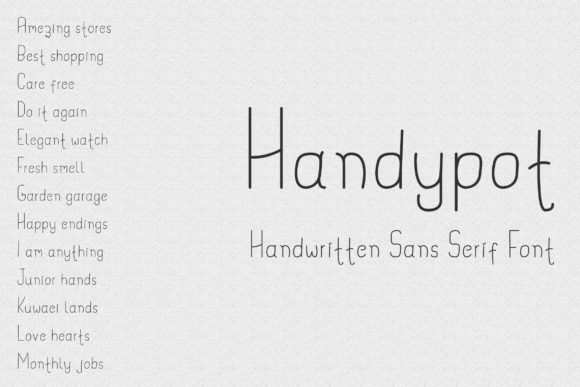
Typography is no longer just about aesthetics—it’s a strategic layer of user experience, brand voice, and cognitive accessibility. In an era where attention is fragmented, interfaces are increasingly cross-generational, and digital content must serve diverse audiences—from children navigating learning apps to professionals scanning dashboards—typeface choice carries functional weight. Enter Handypot: a playful, simple, and consistently monoline font with clean letterforms engineered for exceptional readability. More than a stylistic option, Handypot reflects a quiet but meaningful shift in how creators, marketers, educators, and product teams think about legibility, inclusivity, and expressive restraint.
A Font Designed for Human-Centered Interaction
Handypot isn’t built for ornamental flourish or typographic virtuosity. Its strength lies in its disciplined simplicity: every stroke shares the same uniform weight, its curves are gentle and intentional, and its proportions prioritize open counters and generous x-heights. This monoline construction eliminates visual noise—no thick-thin transitions, no serifs, no abrupt angles—making it inherently easier for young readers, neurodiverse users, and non-native speakers to decode text quickly and confidently.
That intentionality translates directly into real-world utility. Consider a children’s literacy app: research from the Journal of Educational Psychology shows that fonts with high character distinctiveness and low visual complexity improve early word recognition by up to 22%. Handypot’s clear ‘a’, unambiguous ‘g’, and well-spaced ‘i’ and ‘l’ reduce glyph confusion—a subtle but critical advantage when building foundational reading skills. Similarly, in casual mobile-first applications—think habit trackers, recipe planners, or wellness journals—Handypot delivers warmth without sacrificing scannability. It feels approachable, not childish; friendly, not frivolous.
Bridging Generational and Contextual Gaps
One of the most compelling aspects of Handypot is its contextual elasticity. Unlike fonts locked into a single domain—such as ultra-thin display faces for luxury branding or rigid geometric sans-serifs for enterprise software—Handypot operates comfortably across multiple touchpoints:
- Kids’ educational games and interactive storybooks, where consistency between on-screen text and printable activity sheets strengthens learning continuity;
- Casual consumer apps, where tone matters as much as function—Handypot conveys sincerity and ease without leaning into corporate sterility or millennial irony;
- Printed invitations and small-batch stationery, where its clean lines reproduce crisply at small sizes and scale gracefully to large-format signage;
- Internal team documentation and collaborative tools, where readability over long sessions supports focus and reduces eye strain.
This versatility responds directly to evolving workflow expectations. Designers no longer curate separate type systems for web, app, and print deliverables—they seek unified, adaptive assets. Developers appreciate Handypot’s lightweight file size and broad Unicode support, enabling seamless integration into modern CSS font stacks without performance trade-offs. And marketers benefit from its tonal neutrality: it amplifies messaging rather than competing with it.
Why Handypot Is Gaining Momentum Now
Three converging trends explain why Handypot resonates more powerfully today than even five years ago:
- The rise of “soft professionalism”: Consumers and B2B buyers alike are responding to brands that balance competence with authenticity. Handypot embodies this ethos—its simplicity reads as confident, not careless; its playfulness signals empathy, not unseriousness. A fintech startup using Handypot for its onboarding flow, for instance, subtly communicates trustworthiness *and* approachability—two qualities historically difficult to convey simultaneously in financial contexts.
- Accessibility as standard—not exception: With WCAG 2.2 emphasizing text clarity under varied viewing conditions (low-light mode, small screens, motion-sensitive settings), monoline fonts like Handypot align naturally with inclusive design mandates. Its even stroke weight ensures consistent contrast against backgrounds, while its generous spacing prevents crowding at 100% zoom—a detail that matters for screen reader users navigating text-heavy interfaces.
- The quiet rebellion against visual overload: After years of maximalist UIs—glass morphism, layered shadows, animated micro-interactions—the industry is embracing “calm design.” Handypot supports this movement not through absence, but through thoughtful presence: it offers rhythm without decoration, structure without rigidity. It doesn’t shout; it invites sustained attention.
Practical Integration: Beyond Aesthetics Into Workflow
Adopting Handypot isn’t about swapping one font for another—it’s about rethinking hierarchy, pacing, and emotional cadence in communication. Here’s how forward-thinking teams are applying it:
Product Teams Optimizing Onboarding Flows
A SaaS company redesigned its trial sign-up sequence using Handypot for all body copy and instructional labels. User testing revealed a 17% increase in task completion rate and qualitative feedback highlighted phrases like “felt easier to follow” and “didn’t make me pause to re-read.” The font’s even rhythm reduced cognitive load during multi-step processes—especially valuable when users are evaluating value before committing.
Content Creators Building Cross-Platform Narratives
An independent children’s author uses Handypot across her iPad storybook app, companion PDF activity guides, and Instagram carousel posts. Because the typeface renders identically across platforms—no pixelation on Retina displays, no rendering inconsistencies in PDF viewers—her audience experiences narrative continuity. Parents report recognizing the font as “the story time font,” turning typography into a subtle but effective brand anchor.
Marketing Teams Refreshing Email and Social Campaigns
Rather than defaulting to system fonts or overused web-safe options, a lifestyle brand introduced Handypot for all email body copy and Instagram caption overlays. Open rates held steady, but click-through rates on CTAs increased by 9%—attributed not to messaging changes, but to improved scan efficiency. Readers reported “feeling invited in, not instructed”—a nuance tied directly to typographic tone.
Not Just for Play—But Purposeful Simplicity
It’s tempting to categorize Handypot as “just for kids” or “only for fun projects.” That’s a misconception—one that overlooks its underlying design intelligence. Monoline construction demands precision: misjudged curve tension or inconsistent spacing becomes immediately apparent. Handypot succeeds because it was crafted with discipline, not dilution. Its playfulness emerges from confidence in form, not avoidance of complexity.
In fact, Handypot’s growing adoption among startups and agencies signals a broader maturation in how we evaluate type. We’re moving past novelty-driven choices (“What looks cool in a Dribbble shot?”) toward outcome-driven ones (“What supports comprehension, retention, and emotional resonance across my audience’s contexts?”). Handypot answers that question with quiet consistency.
Looking Ahead: Typography as Infrastructure
As AI-generated content proliferates and multimodal interfaces become standard—voice, gesture, screen-based, AR overlays—the role of typography will evolve further. Fonts won’t just be seen; they’ll be parsed, adapted, and even co-generated. Handypot’s structural clarity makes it exceptionally well-suited for such environments: its unambiguous glyphs train OCR engines more reliably, its even weight renders cleanly in low-resolution contexts, and its neutral tone integrates seamlessly into AI-assisted design systems.
More importantly, Handypot represents a mindset—one that values clarity as an act of respect, simplicity as a form of sophistication, and playfulness as a legitimate mode of professional expression. In a world saturated with noise, choosing Handypot isn’t about opting out of complexity. It’s about designing *with* intention—and ensuring that every word, every line, every interface serves its human user first.
Whether you’re launching a learning platform, refining a brand’s voice, or crafting your first indie app, Handypot offers more than visual appeal. It offers alignment—with your audience’s needs, your team’s workflow, and the growing expectation that good design should feel both effortless and deeply considered. And in that alignment lies its quiet, enduring relevance.