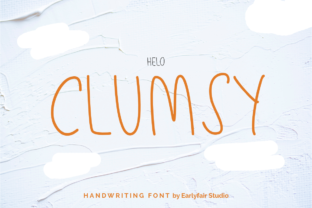
Clumsy: A Friendly, Quirky Script Font That Builds Connection—Not Just Decoration
Clumsy isn’t just another script font. It’s a deliberate design choice—one that signals warmth, approachability, and authenticity without sacrificing modern clarity. For professionals who communicate daily—whether crafting an email newsletter, designing a workshop handout, launching a small-batch product, or building a brand identity—Clumsy offers something rare: personality with purpose. Its uneven baseline, gentle inconsistencies, and hand-drawn charm aren’t flaws. They’re cues. Visual shorthand that says, “This was made by a person—not an algorithm.” And in a world saturated with polished, frictionless interfaces, that distinction matters.
Why Clumsy Works Strategically—Not Just Aesthetically
Fonts shape perception faster than words do. Research in cognitive psychology shows that typeface familiarity and perceived “human effort” directly influence trust and engagement. Clumsy taps into that instinctively. Its slight irregularities mirror natural handwriting—suggesting care, intention, and accessibility. That makes it especially effective when your goal is to soften formality without undermining credibility.
Consider a freelance educator launching a new online course on creative problem-solving. Using Clumsy for the course title and section headers—paired with a clean, highly legible sans-serif like Inter or Open Sans for body text—creates visual hierarchy *and* emotional resonance. Learners don’t just see content; they sense invitation. The same applies to a local bakery’s seasonal menu board, a therapist’s workshop flyer, or a sustainability nonprofit’s impact report summary. In each case, Clumsy supports the message by reinforcing values: human-centered, grounded, thoughtful.
Where Clumsy Adds Real Value—And Where It Doesn’t
Clumsy shines in contexts where tone and relationship-building are primary objectives—and legibility at scale is secondary. It’s strongest in:
- Branded touchpoints with limited text: Logo lockups, social media banners, packaging accents, email subject lines, presentation slide titles.
- Printed materials meant for short attention spans: Workshop worksheets, event signage, greeting cards, product labels, illustrated guides.
- Digital interfaces where personality differentiates: Landing page headlines, CTA buttons with short verbs (“Start Here”, “Join Us”), testimonial pull-quotes.
It’s less effective—and potentially counterproductive—in situations demanding speed, precision, or broad accessibility: legal disclaimers, data dashboards, multi-step forms, long-form blog posts, or mobile-first navigation menus. Clumsy’s charm relies on context. Used without strategic alignment, it can unintentionally signal informality where authority is expected—or distract where clarity is essential.
Three Practical Decisions Before You Use Clumsy
Before dropping Clumsy into your next project, ask yourself these questions—not once, but iteratively:
- What outcome am I optimizing for? If the goal is conversion rate on a pricing page, Clumsy may dilute urgency. If the goal is emotional resonance in a brand story video thumbnail, it may deepen recall.
- Who needs to read this—and under what conditions? A teacher printing Clumsy-heavy worksheets for 10-year-olds must consider readability across varied vision abilities and printer quality. A marketer designing Instagram Stories should test how Clumsy renders on small OLED screens at different brightness levels.
- Does this support—or compete with—my core message? Clumsy adds tonal weight. If your message is “We reduce compliance risk,” pairing it with Clumsy risks undercutting seriousness unless carefully balanced (e.g., using it only in the tagline: “Compliance, made human”).
Pairing Clumsy Intentionally—Not Decoratively
Clumsy gains strength through contrast. Its quirkiness becomes meaningful when anchored by structure. Think of it as the voice, not the vocabulary. A successful pairing balances rhythm, weight, and function:
- For digital publishing: Use Clumsy at 28–42px for H1s, then switch to a neutral, highly legible sans-serif (like Inter, Manrope, or Source Sans Pro) for all body copy, captions, and interface labels.
- For print design: Set Clumsy at 18–24pt for headings, then use a serif with open counters (like Merriweather or Lora) for body text—especially in longer documents where typographic warmth supports sustained reading.
- For branding systems: Reserve Clumsy for expressive moments only—signature lines, campaign slogans, handwritten-style annotations. Never use it for contact details, URLs, or legal footers.
This isn’t about rules for their own sake. It’s about directing attention. Clumsy draws the eye—and the mind—to what’s emotionally significant. Everything else should recede, quietly enabling understanding.
Risks of Using Clumsy Without Strategy
When deployed casually—“because it looks cute”—Clumsy can erode credibility rather than build it. Common missteps include:
- Overuse across touchpoints: A website where every heading, button, and testimonial uses Clumsy feels unedited, not charming. It sacrifices scannability and increases cognitive load.
- Ignoring technical constraints: Clumsy has limited OpenType features and variable weight options. Relying on bolding or scaling to create emphasis often distorts its proportions, weakening its authenticity.
- Misaligning with audience expectations: A fintech startup targeting enterprise clients may find Clumsy undermines perceived stability—even if used sparingly. The mismatch isn’t about “good” or “bad” design; it’s about contextual fit.
These aren’t failures of the font. They’re symptoms of unclear intent. Clumsy doesn’t carry meaning on its own—it reflects the decisions behind it.
Long-Term Thinking: How Clumsy Fits Into Brand Evolution
Brands mature. Audiences shift. Tools change. A font chosen for a solo creator’s first website may no longer serve that same person five years later—as a team lead, course instructor, or published author. Clumsy’s value isn’t in permanence, but in flexibility: it adapts when paired thoughtfully with evolving systems.
One practical approach: treat Clumsy as a *layer*, not a foundation. Build your core typography system around robust, accessible, scalable fonts first. Then introduce Clumsy as a controlled accent—defined in your style guide with precise usage rules (e.g., “Clumsy is permitted only in H1s on marketing landing pages and in handwritten-style callouts within educational PDFs”). This preserves consistency while allowing room for warmth.
That discipline pays off. When stakeholders ask, “Why does this feel so human?” you’ll have a clear answer—not just “it looks nice,” but “we chose Clumsy here because it reinforces our commitment to approachable expertise, and we limit it to ensure every instance serves that goal.” That kind of intentionality builds trust far beyond aesthetics.
Getting Started—Without Overcommitting
You don’t need to redesign everything to test Clumsy’s strategic fit. Try one low-risk, high-visibility experiment:
- Redesign your email newsletter’s header using Clumsy—keep everything else unchanged. Track open rates *and* reply sentiment for two cycles.
- Add Clumsy to a single customer onboarding step—like the welcome screen in your web app—and observe completion time and support ticket volume related to that flow.
- Use it in one printed asset—a workshop handout, a thank-you card for clients—and ask three people from your target audience what feeling it evokes before revealing the font name.
Measure what matters to your goals—not just “do they like it,” but “does it move the needle on attention, clarity, or connection?” That’s how Clumsy stops being decorative and starts becoming functional.
At its best, Clumsy reminds us that communication isn’t just about transmitting information. It’s about signaling shared ground. In a landscape increasingly mediated by AI, automation, and efficiency metrics, choosing Clumsy—mindfully, deliberately, sparingly—is itself a quiet act of human-centered strategy.