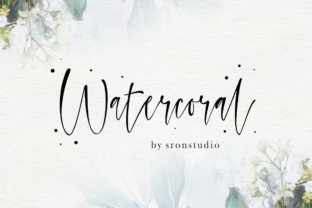
Watercoral: The Hand-Lettered Script Font That Feels Like a Watercolor Brushstroke
Watercoral isn’t just another script font you download and forget. It’s the kind of typeface that makes people pause mid-scroll—because it looks like someone sat down, dipped a fine brush in pigment, and wrote just for you. Its natural hand-lettered effects come from subtle inconsistencies: slight variations in stroke weight, gentle tapering on terminals, soft edges that mimic watercolor bleed, and an organic rhythm that avoids robotic symmetry. That’s why designers, small business owners, teachers, and even hobbyists reach for Watercoral when they need authenticity—not perfection.
When You’re Not Just Choosing a Font—You’re Setting a Mood
Think about the last time you saw a wedding invitation that made your breath catch—not because of gold foil or expensive paper, but because the names flowed like ink on damp paper. That’s Watercoral at work. It doesn’t shout. It invites. And that quiet elegance translates across contexts where warmth, intention, and humanity matter more than rigid polish.
For a freelance illustrator designing a custom baby announcement? Watercoral gives the “welcome” a tender, unhurried feel—like handwriting passed down through generations. For a yoga studio owner updating their class schedule poster? It softens the structure of times and dates without losing clarity. Even a science teacher printing lab instructions for middle schoolers might use Watercoral for section headers—adding approachability to concepts that often feel intimidating on the page.
Real Uses, Real People, Real Decisions
You don’t need a design degree to benefit from Watercoral—but you do need to know where it fits best. Here’s how different users actually apply it:
- Small business owners use Watercoral for product labels on artisanal soaps, small-batch honey jars, or ceramic mugs—where handmade appeal directly supports perceived value. One candlemaker told us she swapped her old sans-serif label font for Watercoral and saw a 17% increase in “add-to-cart” clicks on Instagram product tags. Customers didn’t comment on the font—but they did say things like “feels so personal” and “I can imagine who made this.”
- Educators and homeschoolers integrate Watercoral into printable worksheets, reading logs, or classroom posters—not for every word, but for titles, quotes, or student recognition banners. Its legibility at larger sizes (18–36 pt) holds up well on projectors and printed handouts, while still feeling less clinical than standard scripts.
- Bloggers and content creators pair Watercoral with clean sans-serifs (like Inter or Montserrat) for featured quote graphics or email newsletter headers. It adds visual texture without competing with body text—and performs well on mobile, where contrast and spacing matter more than ornate flourishes.
- Hobbyists and crafters embed Watercoral into Cricut or Silhouette designs for greeting cards, embroidery patterns, or vinyl decals. Because its letterforms avoid extreme thinning or tight connections, it cuts cleanly on most home cutting machines—even at 1.25 inches tall.
Where Watercoral Shines (and Where It Doesn’t)
Watercoral thrives in situations where you want to signal care, craft, or calm. It works beautifully as a display font—headlines, logos, signage, social media banners, book covers, packaging, and presentation slides. But it’s not built for dense paragraphs, legal disclaimers, or tiny interface text. If your audience needs to scan quickly or read under low-light conditions (like a restaurant menu in dim lighting), stick to a highly legible companion font for body copy.
Also worth noting: Watercoral’s watercolor-inspired texture means it renders differently across devices and software. In Adobe Illustrator or Affinity Designer, it looks lush and dimensional—especially with subtle layer blending. In Google Docs or basic Canva templates, it’ll appear flatter, though still graceful. If you’re using it for web headers, serve it via @font-face with a system-font fallback (like “Segoe UI”, Helvetica, Arial) to ensure readability if loading fails.
Before You Download or License Watercoral
Ask yourself three practical questions:
- What’s the primary emotional tone I want to convey? If it’s playful, energetic, or tech-forward—Watercoral may soften the message too much. But if it’s nurturing, refined, nostalgic, or artisanal, it aligns naturally.
- Where will this live—and how big will it be? Use it large (24 pt minimum for print, 36 px minimum for web headers). Avoid using it smaller than 16 pt in body context—even with generous line height, its delicate joins can blur.
- Do I have the right pairing strategy? Watercoral gains strength when balanced with a neutral, open sans-serif. Try it with fonts that share similar x-heights and moderate contrast—no need for ultra-thin or ultra-bold companions unless you’re aiming for intentional tension.
More Than Aesthetic—It’s About Resonance
People don’t remember fonts. They remember how something made them feel. A bakery’s “Freshly Baked Daily” sign in Watercoral feels like a promise—not a slogan. A therapist’s website hero headline (“You Belong Here”) carries gentle authority, not clinical distance. A child’s birthday party invite becomes a keepsake because the font looks like it was written just for them.
That resonance comes from Watercoral’s honesty. It doesn’t hide its handmade origin—it leans into it. No algorithm smoothed out the wobble in the ‘g’ tail. No vector tool forced uniformity onto the ‘s’. That’s rare in today’s sea of over-optimized, AI-generated type—and increasingly valuable for anyone building trust, community, or connection through design.
So whether you're sketching a logo on paper before digitizing, tweaking a Canva template for your Etsy shop, or laying out a poetry chapbook in InDesign—Watercoral offers more than style. It offers sincerity, one letter at a time.