Sunset Skies
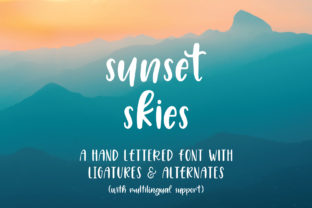
There’s a quiet shift happening in how we choose type—not toward bolder, sharper, or more technical fonts, but toward ones that feel human first. Sunset Skies is part of that movement: a smooth hand-lettered font designed with intention, not algorithm. It doesn’t shout. It leans in—friendly, legible, quietly confident. And because it balances personality with clarity, it fits where many display fonts falter: real-world applications where charm and function must coexist.
Why Readability Still Matters—Especially When It’s Hand-Lettered
Hand-lettered fonts often sacrifice legibility for character. That’s understandable—brush strokes, ink bleeds, and organic variation are part of their appeal. But Sunset Skies avoids that trade-off. Its letterforms are open, its spacing generous, and its contrast gentle—not so low as to blur at small sizes, not so high as to feel rigid. You can read it comfortably on a mobile screen at 16px, yet it holds presence at 60px on a banner or social graphic.
This balance responds to actual usage patterns. Designers aren’t just making posters or logos anymore—they’re building email headers, Instagram story overlays, course landing pages, and product packaging. In each case, the type needs to communicate quickly *and* reflect tone. A playful brand voice shouldn’t come at the cost of comprehension. Sunset Skies delivers both without compromise.
From Trend to Tool: How Playful Typography Fits Modern Workflows
“Playful” used to mean “for kids’ books” or “summer sale banners.” Today, it signals approachability—especially in spaces where trust and warmth matter: wellness brands, independent education platforms, sustainable product labels, and creator-led newsletters. People don’t want sterile interfaces or corporate monotony; they respond to visual cues that suggest care, authenticity, and intention.
What makes Sunset Skies practical in this context isn’t just its aesthetic—it’s its versatility across tools and outputs. It’s optimized for web use (with WOFF2 support), works cleanly in Figma and Adobe Creative Cloud, and renders consistently across browsers and devices. That means you can drop it into a Canva template for a client pitch, use it in a Notion dashboard header, or layer it over a muted photo background in an email campaign—all without adjusting kerning manually or worrying about fallbacks.
Evolving Expectations Around Customization and Control
A few years ago, designers relied heavily on variable fonts or extensive stylistic sets to get nuance from a single family. Now, there’s growing appreciation for focused, purpose-built fonts like Sunset Skies—ones that do one thing exceptionally well, rather than trying to be everything. This reflects broader shifts: professionals value speed, consistency, and emotional resonance over exhaustive options.
For example, a freelance educator launching a workshop series might need a font that feels inviting but still conveys expertise. They’re unlikely to spend hours toggling between alternate glyphs or adjusting axis values. Instead, they’ll choose a font like Sunset Skies because its rhythm and weight feel right *immediately*. No tweaking needed. That saves time—and preserves creative energy for messaging, structure, and audience connection.
Where Personality Meets Practicality in Real Projects
Consider three everyday scenarios:
- A small-batch candle brand uses Sunset Skies for product tags and Instagram captions. The font echoes the handmade quality of their goods without looking childish—its curves feel warm, not cutesy, and its readability ensures scent names like “Coastal Sage & Amber” stay legible even in natural light photos.
- An online course creator applies it to section headers in their LMS and downloadable workbooks. Learners report the interface feeling “less intimidating”—a subtle but meaningful shift when teaching complex topics like financial literacy or mindfulness practices.
- A local café prints weekly specials on chalkboard-style menus using Sunset Skies as a digital base before hand-tracing. The font’s natural flow guides the hand, resulting in consistent, cohesive signage—even when multiple staff members contribute.
In each case, the font supports intent—not just decoration. It helps convey care, clarity, and continuity across touchpoints, which strengthens recognition and recall without requiring a full rebrand.
Not Just for “Creative” Projects—But for Clarity Across Contexts
Some assume hand-lettered fonts belong only in lifestyle or artistic contexts. But Sunset Skies proves otherwise. Its strength lies in restraint: no exaggerated swashes, no unpredictable ligatures, no forced quirkiness. That makes it suitable for contexts where tone matters but formality isn’t required—think internal team dashboards, nonprofit impact reports, or community newsletter headers.
One nonprofit communications manager shared how they switched from a generic sans-serif to Sunset Skies for donor update emails. Open rates held steady, but reply rates increased slightly—and more importantly, comments from long-time supporters included phrases like “feels more like a conversation” and “easier to read on my phone while commuting.” That’s not magic. It’s thoughtful design meeting real behavior.
Choosing Type in an Age of Attention Scarcity
We’re not short on fonts—we’re short on time, focus, and trust. Every design decision competes for attention, and every visual cue either builds or erodes credibility. A font that looks hastily chosen—or overly trendy—can undercut even strong content. Sunset Skies avoids that pitfall by grounding its playfulness in craftsmanship: each letter was drawn, refined, and tested for legibility across mediums.
That level of intention aligns with how professionals actually work today. They’re less likely to hunt for “the next big thing” and more likely to seek reliable tools that integrate smoothly, scale gracefully, and support their goals—not distract from them. It’s why Sunset Skies appears in brand guidelines alongside workhorse sans-serifs and serif text faces: not as a novelty, but as a considered complement.
A Font That Grows With Your Needs
Design systems evolve. Brands refine their voice. Audiences change. A font that feels fresh and fitting today should still serve you two years from now—not as a relic of a past trend, but as a stable, expressive element in your toolkit. Sunset Skies achieves that by avoiding extremes: it’s not so casual it feels unprofessional, nor so polished it loses warmth.
That durability matters—especially for solopreneurs, educators, and small teams who may not have dedicated design resources. They need fonts that work out of the box, adapt to new formats (like dark mode or accessibility settings), and maintain cohesion whether viewed on a desktop monitor or a smartwatch notification preview.
It’s also why Sunset Skies pairs well with neutral typefaces like Inter, Lora, or Manrope. It brings character to headings while letting body text remain functional and inclusive. That kind of thoughtful pairing reflects how modern typography is increasingly used—not as isolated decoration, but as part of a responsive, layered system.
Final Thought: Human-Centered Design Starts With the Details
Typography is never just about letters. It’s about pacing, empathy, and perception. When someone sees Sunset Skies, they’re not just reading words—they’re sensing tone, judging reliability, and deciding whether to stay or scroll. That’s a lot of responsibility for a set of glyphs. But Sunset Skies handles it with grace: smooth where it needs to be, clear where it counts, and quietly memorable where it lingers.
So if you’re choosing type for a project—whether it’s a personal portfolio, a client website, or a classroom handout—consider what you want people to feel *before* they finish reading the first sentence. Because sometimes, the most effective design choices aren’t the loudest ones. They’re the ones that make people feel seen, welcomed, and ready to engage—starting with the very first letter.