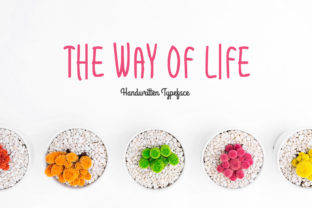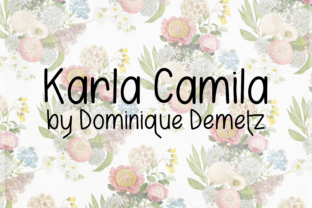
Karla Camila: Handwritten Warmth in a Digital-First World
There’s something quietly powerful about seeing words that look like they were written by hand—not perfectly aligned, not uniformly spaced, but alive with rhythm and intention. Karla Camila captures that feeling with remarkable authenticity. It’s not just another script font; it’s a carefully crafted handwritten typeface designed to feel human first, digital second. Its subtle variations in stroke weight, natural entry and exit flourishes, and organic spacing mimic the way ink flows across paper—without sacrificing legibility or versatility in modern design environments.
Why Handwriting Still Matters—Even When Everything’s Automated
In an era of AI-generated content, algorithm-driven layouts, and templated social feeds, audiences are responding more strongly to signals of authenticity. Studies in digital psychology show that users spend longer engaging with visuals that include human-made elements—especially in branding, email marketing, and educational materials. A 2023 HubSpot survey found that 68% of consumers said they’re more likely to trust a brand whose communications feel “personally crafted,” not mass-produced. That’s where Karla Camila steps in—not as a novelty, but as a functional tool for signaling care, approachability, and individuality.
This isn’t about rejecting efficiency. It’s about balancing it. Designers aren’t abandoning system fonts for body text or swapping out sans-serifs for headlines en masse. Instead, they’re using fonts like Karla Camila strategically: in logos that need warmth, on landing pages where conversion hinges on emotional resonance, or in course materials where learners respond better to instructor-led tone than sterile corporate language.
How Karla Camila Fits Real Creative Workflows Today
Unlike many decorative scripts, Karla Camila was built with practical use in mind. It includes full Latin character sets, standard punctuation, numerals, and OpenType features like contextual alternates and ligatures—meaning it adapts gracefully across platforms. You can use it confidently in Figma, Adobe Creative Cloud, Canva, and even web projects via variable font files or WOFF2 embedding.
Consider a freelance educator launching a new workshop series. Instead of defaulting to Montserrat or Poppins for all headings, they might pair Karla Camila for section titles (“What You’ll Build Together”) with a clean, highly readable sans-serif for supporting text. The contrast reinforces voice without compromising scannability. Or imagine a small-batch skincare brand designing product labels: Karla Camila lends intimacy to ingredient stories or founder notes—text that customers actually read and remember—while keeping technical details (net weight, certifications) in a neutral, accessible typeface.
It’s also resilient across formats. A newsletter header set in Karla Camila holds up well on mobile, especially when paired with appropriate line height and letter spacing. And because its x-height is generous and its lowercase forms are open and friendly, it remains legible at smaller sizes—unlike many ultra-thin or tightly spaced scripts that vanish on screens under 18px.
From Niche Choice to Thoughtful Differentiation
Handwritten fonts used to carry stigma: “unprofessional,” “too casual,” or “hard to read.” But expectations have shifted—not because standards lowered, but because communication goals evolved. We no longer optimize solely for authority or uniformity. We optimize for connection, clarity within context, and consistency *with purpose*. Karla Camila reflects that maturity: it doesn’t try to be everything. It excels where warmth and intentionality matter most.
This evolution mirrors broader changes in how creatives source and evaluate tools. Designers today often curate type libraries based on narrative function—not just aesthetics. They ask: Does this font help tell the right part of the story? Does it support the user’s next action—or distract from it? Karla Camila answers “yes” in specific, high-impact moments: welcome emails, handwritten-style callouts in presentations, limited-edition packaging, or personal portfolio headers that invite curiosity rather than assert dominance.
Practical Tips for Using Karla Camila Well
Like any expressive font, Karla Camila benefits from thoughtful application. Here’s what works—and what to avoid:
- Do use it for short, high-intent text: headlines, quotes, buttons (“Start Your Journey”), signature lines, or branded section dividers. Its personality shines brightest when given room to breathe.
- Avoid long paragraphs or dense captions: while legible, its expressive nature slows reading speed. Reserve it for moments where you want the audience to pause—not skim.
- Pair intentionally: it harmonizes beautifully with warm neutrals (soft greys, oat tones) and clean, low-contrast sans-serifs like Inter, Lato, or Manrope. Avoid clashing with other display fonts or overly geometric typefaces unless the contrast serves a clear conceptual goal.
- Test across devices early: preview how Karla Camila renders on iOS vs. Android, in dark mode, and at different zoom levels. Subtle flourishes may soften or sharpen depending on rendering engines—so adjust tracking or size as needed, not just for aesthetics but for functional readability.
- Respect hierarchy: if your brand uses Karla Camila for primary headlines, don’t dilute its impact by applying it to secondary navigation or footer links. Let it anchor meaning—not fill space.
Looking Ahead: Human-Centered Typography as Infrastructure
Typography is no longer just about appearance—it’s infrastructure for attention, trust, and interpretation. As tools become smarter and interfaces more adaptive, the value of intentional, human-inflected choices only increases. Karla Camila doesn’t predict the future of type; it responds to where we are now: seeking balance between speed and sincerity, automation and artistry, scalability and soul.
This is especially relevant for solopreneurs and micro-businesses who rely on perception as much as product. When your website, pitch deck, or Instagram bio is often the first—and sometimes only—point of contact, every visual cue counts. Karla Camila offers a quiet but effective way to say, “I made this for you,” without saying it aloud.
It’s also gaining traction among educators building asynchronous learning experiences. In a landscape saturated with AI-narrated videos and templated slides, instructors using Karla Camila for slide titles or reflection prompts report higher student engagement in discussion forums—likely because the font subtly cues a human presence behind the material.
Not Just a Font—A Signal of Intention
Choosing Karla Camila isn’t about chasing trendiness. It’s about recognizing that how something looks influences how it’s received—and that in crowded digital spaces, warmth isn’t softness. It’s strategy. It’s clarity wrapped in familiarity. It’s the difference between being seen and being remembered.
That’s why designers, marketers, and educators continue to return to it—not as a one-off experiment, but as a reliable part of their toolkit. Not because it’s flashy, but because it’s faithful: faithful to craft, to context, and to the people on the other side of the screen.
If you’ve been hesitant to try handwritten typography, start small. Replace one static headline on your homepage. Add it to a thank-you note in your email sequence. Use it for the title of your next presentation slide—not the bullet points beneath it. Observe how it shifts tone, pacing, and perceived effort. You’ll likely find that Karla Camila doesn’t draw attention to itself. Instead, it helps your message land—gently, clearly, and unmistakably human.