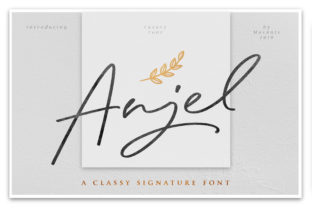
Anjel: The Luxury Signature Font That Elevates Real-World Design
Imagine a font that doesn’t just sit on the page—but whispers confidence, refinement, and quiet authority. Anjel is exactly that: a meticulously crafted luxury signature font designed for moments where first impressions aren’t just important—they’re decisive. It’s not a display font built for shouting; it’s a graceful, high-contrast serif with elegant terminals, subtle calligraphic rhythm, and generous letter spacing that breathes sophistication into every use case.
Where Anjel Fits Naturally—Not Just Where It *Could* Fit
Designers don’t reach for Anjel when they need something generic or safe. They reach for it when the stakes are personal, the audience is discerning, and the message deserves distinction. Here’s where it lands with quiet impact:
- Wedding stationery that feels like heirloom paper—not just invitations, but monogrammed napkins, foil-stamped menus, and delicate thank-you notes. Anjel’s soft curves and balanced weight lend warmth without sacrificing polish. One Brooklyn-based stationer told us her clients consistently choose Anjel over alternatives because “it looks handwritten—but never rushed.”
- Small-batch product branding, especially in beauty, ceramics, or artisanal food. Think gold-embossed labels on olive oil bottles, minimalist apothecary jars, or linen tea sachet tags. Its legibility at small sizes (down to 10 pt in print) means it works on tiny surfaces without losing character.
- Editorial watermarks and bylines in high-end magazines. Unlike aggressive display fonts that dominate layouts, Anjel adds authorial presence—subtle enough to avoid visual competition with photography, strong enough to signal craftsmanship. Vogue Italia’s digital archive team used it for contributor signatures in their “Crafted Voices” series, noting how it reinforced tone without distracting from image storytelling.
Who Benefits—and How Their Needs Shape Usage
Anjel serves different people in different ways—not because it’s flexible, but because its clarity and restraint make it adaptable without compromise.
Freelance designers appreciate how Anjel shortens client revision cycles. When presenting logo concepts for a boutique law firm or a heritage watchmaker, pairing Anjel with a clean sans-serif (like Neue Haas Grotesk or IBM Plex Sans) creates immediate visual hierarchy—no need to explain “why this feels premium.” It communicates intention before the pitch begins.
In-house brand managers rely on Anjel for consistency across touchpoints. One sustainability-focused skincare brand uses it exclusively for founder quotes in email campaigns, social bios, and limited-edition packaging. Because Anjel includes full OpenType features—small caps, discretionary ligatures, and stylistic alternates—it scales gracefully from Instagram captions (where the light weight shines) to embossed business cards (where the regular weight holds texture beautifully).
Photographers and artists use Anjel as a watermark that enhances, not obscures. Its tall x-height and open counters ensure readability even at 15% opacity over complex backgrounds—unlike many script fonts that vanish into shadows or grain. And because it avoids exaggerated flourishes, it doesn’t compete with composition; it complements it.
Practical Considerations Before You Apply It
Anjel isn’t a one-size-fits-all solution—and that’s part of its strength. Knowing when (and when not) to reach for it saves time and preserves impact.
Think about contrast first. Anjel thrives alongside clean, uncluttered layouts. Pair it with generous whitespace, restrained color palettes (think charcoal, oat, deep indigo), and high-quality substrates—matte cotton paper, soft-touch laminates, brushed metal. It won’t rescue a busy background or compensate for poor hierarchy.
Consider your medium carefully. While it renders beautifully in print and high-res digital displays, avoid using Anjel for body text below 14 pt on standard web screens—it wasn’t built for long-form reading. Likewise, steer clear of low-DPI environments (like basic thermal receipt printers or low-res signage) where fine serifs may blur or break up.
License alignment matters. Anjel is offered with commercial licenses covering web, app, and desktop use—but always verify scope. If you’re building a SaaS dashboard where Anjel appears in user-generated reports, confirm your license includes embedded usage. Some foundries offer extended options for large-scale deployments; it’s worth checking before scaling.
Strengths That Solve Real Problems
What makes Anjel stand out isn’t novelty—it’s resolution. It solves recurring pain points with elegance:
- No more “too formal” or “too casual” dilemmas. Its balance of structure and fluidity bridges corporate gravitas and creative warmth—ideal for brands evolving beyond startup energy but not yet ready for legacy stiffness.
- Instant tonal calibration. Swap Anjel in for a generic serif in a mood board, and clients often say, “Yes—that’s the feeling we wanted.” It acts like a design shortcut for emotional resonance.
- Scalable authenticity. Unlike fonts that feel “designed,” Anjel reads as human—crafted, not generated. That authenticity translates across cultures and age groups, which is why it’s appeared in bilingual luxury campaigns from Seoul to Lisbon without needing adaptation.
A Few Gentle Limitations to Keep in Mind
Anjel is intentional—not universal. Its strengths come with natural boundaries:
It’s not meant for data-heavy interfaces, multilingual publishing with extensive diacritics (though it supports Latin Extended-A well), or ultra-narrow vertical spaces like mobile app tabs. And while it includes italics, they’re true obliques—not fully redrawn cursive forms—so they’re best used for emphasis, not extended narrative passages.
Also, because Anjel leans into subtlety, it can get lost in noisy environments—think trade show banners next to flashing LED walls or dense social feeds packed with bold thumbnails. In those cases, its power lies in restraint: use it sparingly, deliberately, and always with breathing room.
Real Projects, Not Just Possibilities
You’ll find Anjel anchoring real work: the engraved brass plaque on a Greenwich Village architecture studio’s front door; the hand-pressed letterpress poster for a jazz festival in New Orleans; the embroidered monogram on custom cashmere throws sold through a Parisian concept store. These aren’t hypotheticals—they’re documented applications where Anjel didn’t just “work,” but elevated context, deepened trust, and quietly signaled quality before a single word was read.
One interior designer shared how she began using Anjel for client presentation decks after noticing how often prospects paused on slides featuring her project titles set in it. “They’d ask, ‘Is that your logo font?’ even though it wasn’t. That’s when I realized it wasn’t just typography—it was tone-setting infrastructure.”
If you're weighing whether Anjel fits your next project, ask yourself: Does this need to feel considered—not just finished? Does the audience value craft over convenience? Is the goal to resonate, not just register? When the answer leans yes, Anjel isn’t just appropriate—it’s quietly inevitable.