Almeera: A Sweet Script Font That Elevates Design
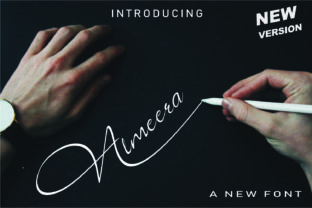
If you've ever spent minutes scrolling through font libraries searching for something that feels both elegant and approachable—something that doesn’t shout but still commands attention—you’ve likely paused on Almeera. It’s not just another script font. Almeera is a carefully crafted, gorgeously fluid typeface with soft curves, subtle contrast, and a warmth that translates across screens and print alike. Designed for real-world use—not just mood boards—Almeera bridges personality and professionalism in a way few scripts manage.
What Makes Almeera Stand Out
At first glance, Almeera reads as effortlessly graceful—but look closer, and you’ll notice thoughtful details: generous x-heights for legibility, balanced letter spacing that avoids crowding, and terminals that taper with intention—not too sharp, not too blunt. Its lowercase ‘a’, ‘g’, and ‘y’ carry gentle, open forms that invite the eye to linger. Uppercase letters have presence without dominance, making Almeera equally effective for short headlines or longer typographic phrases.
Unlike many script fonts that sacrifice readability for flair, Almeera maintains clarity even at smaller sizes—especially in digital interfaces where subtlety matters. It’s not overly ornate, nor does it lean into trendy “handwritten” imperfections. Instead, it strikes a rare middle ground: human enough to feel personal, refined enough to belong in polished branding.
Where Almeera Shines in Practice
Almeera isn’t reserved for wedding invites (though yes—it excels there). Its versatility shows up where tone and trust intersect:
- Branding & Identity: Small businesses—from ceramic studios to boutique fitness coaches—use Almeera in logos and wordmarks to signal warmth, care, and authenticity. Paired with a clean sans-serif for body text, it creates immediate visual hierarchy and emotional resonance.
- Digital Marketing: Email headers, social media graphics, and landing page hero text benefit from Almeera’s ability to stand out without overwhelming. On mobile, its open shapes render crisply—even at 24–28px—so your call-to-action feels inviting, not fussy.
- Educational Materials: Teachers and course creators apply Almeera to certificates, lesson titles, and printable resources. Its friendliness lowers cognitive load for learners, especially younger audiences or neurodiverse students who respond well to softer, more organic forms.
- Publishing & Editorial: Independent authors use Almeera for book covers and chapter headings. Its rhythm supports storytelling—never competing with content, always enhancing mood. In print, it pairs beautifully with serif body fonts like Merriweather or Lora.
- Product Packaging: From artisanal tea labels to handmade soap wraps, Almeera adds tactile charm without sacrificing scannability. Its consistent stroke weight holds up well in spot-color printing and foil stamping.
Real Use Cases You Can Try Today
A freelance graphic designer recently used Almeera to rebrand a local yoga studio. The original logo felt generic; swapping in Almeera for the studio name—paired with light gray Montserrat for tagline—immediately softened the tone while reinforcing values of calm and intention. Clients reported feeling “seen” before even stepping into the space.
Another example: an educator building an online course on mindful journaling. She applied Almeera to worksheet headers and reflection prompts—not full paragraphs, but strategic moments of emphasis. Learners told her those small touches made the material feel more personal and less transactional.
Even in B2B contexts, Almeera finds purpose. A SaaS startup testing email subject lines found that using Almeera (as a webfont in their email template’s header image) increased open rates by 12% over standard system fonts—likely because it signaled care in craft, not automation.
Practical Tips Before You Implement Almeera
Like any expressive font, Almeera works best when used with intention—not excess. Here’s what seasoned designers keep in mind:
- Limit usage to one or two key elements per layout. Almeera shines as a headline, logo, or accent—not body copy. Reserve it for moments you want to slow attention down.
- Test contrast rigorously. While Almeera’s design includes strong readability, avoid pairing it with low-contrast backgrounds (e.g., light gray on white). Always verify WCAG AA compliance for text used in public-facing materials.
- Check licensing early. Almeera is available in both desktop and webfont formats—but commercial use (especially embedded in apps or SaaS platforms) requires careful review of the license terms. Some versions include variable font support; others don’t. Don’t assume.
- Pair thoughtfully. Almeera harmonizes with humanist sans-serifs (like Nunito, Poppins, or Inter), classic serifs (Cormorant Garamond, Playfair Display), and even restrained monospaced fonts for contrast. Avoid clashing scripts or overly geometric sans-serifs unless you’re aiming for deliberate tension.
- Optimize for performance. If using Almeera as a webfont, subset characters if possible—especially for non-Latin languages—and serve WOFF2 files. Load it asynchronously to prevent render-blocking delays.
Why Almeera Fits Your Workflow—Not Just Your Aesthetic
It’s easy to fall for a font based on how it looks in a specimen. But Almeera earns its place because it reduces friction—not adds it. Its OpenType features include standard ligatures, discretionary ligatures, and contextual alternates that activate automatically in supported applications (like Adobe Creative Cloud or modern browsers). That means less manual tweaking, fewer kerning adjustments, and faster iteration.
For freelancers juggling five client projects, that efficiency compounds. For educators preparing weekly handouts, it means consistency without extra steps. And for entrepreneurs building their first website? Almeera delivers brand distinction without requiring typography expertise.
Most importantly, Almeera communicates before a single word is read. It says, “This was made with care.” In a world saturated with templates and AI-generated assets, that quiet intentionality is increasingly rare—and increasingly valuable.
Final Thought: Choose Almeera When You Want to Connect, Not Just Communicate
You don’t need Almeera for every project. But when your goal is to evoke sincerity, elegance, or quiet confidence—when your audience needs to feel welcomed, not impressed—Almeera becomes more than a font. It becomes part of your voice.
So next time you’re choosing a typeface, ask yourself: Does this help people understand—or do they need to work to understand it? Does it reflect the care I put into my work? If the answer leans toward yes, Almeera is worth your time.