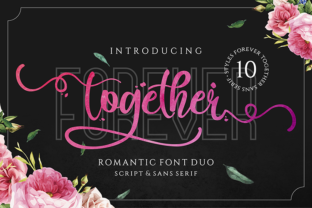
Forever Together Duo: A Strategic Font Pairing for Purpose-Driven Design
Typography is rarely just about aesthetics—it’s a functional decision with measurable impact on clarity, credibility, and connection. The Forever Together Duo stands out not because it’s trendy, but because it’s intentionally engineered: a harmonious pairing of a refined script font and a clean, confident sans serif. This isn’t a decorative combo; it’s a design system built for alignment—between voice and vision, message and audience, intention and execution.
Why This Duo Matters Beyond Visual Appeal
Most designers reach for font pairings instinctively—matching weight or contrast without assessing strategic fit. The Forever Together Duo invites a different approach: one rooted in purpose. Its script carries warmth, personality, and human nuance—the kind that signals authenticity in a founder’s letter, a wedding invitation, or a boutique brand’s tagline. Its companion sans serif grounds that expression with structure, legibility, and quiet authority—ideal for body text, captions, pricing, or interface labels. That balance isn’t accidental. It supports dual objectives: emotional resonance *and* functional reliability.
For entrepreneurs launching a service-based business, that duality translates directly to trust-building. A hand-drawn script headline (“Your Vision, Realized”) paired with crisp sans serif subtext (“Custom strategy sessions • 1:1 coaching • Monthly progress reviews”) tells a cohesive story—one where creativity meets consistency. For educators designing course materials, the same pairing helps distinguish conceptual ideas (in script) from actionable steps (in sans serif), supporting cognitive processing without visual noise.
When Strategic Pairing Outperforms Stylistic Choice
Using the Forever Together Duo becomes strategic—not stylistic—when it aligns with your communication goals *before* you open your design tool. Ask: What outcome do I need this piece to support? Is it conversion? Clarity? Memorability? Emotional engagement? If the answer is more than one, this duo earns its place.
Consider these grounded use cases:
- Brand identity systems: Small businesses often over-invest in logos while under-investing in typographic hierarchy. With Forever Together Duo, a single pairing can define tone across business cards, email signatures, social banners, and sales pages—reducing decision fatigue and reinforcing recognition.
- Printed collateral with limited real estate: A brochure for a wellness retreat might use the script for “Breathe Deeply” and the sans serif for session times, facilitator bios, and booking instructions—maximizing emotional pull *and* scannability in tight layouts.
- Digital product interfaces: In SaaS dashboards or learning platforms, the script can highlight key milestones (“You’re halfway there!”), while the sans serif handles navigation, form fields, and error messages—guiding users without compromising usability.
Planning Your Use: Intention Before Implementation
Adopting the Forever Together Duo without planning risks inconsistency—not just visually, but conceptually. Start by auditing existing touchpoints: Where do you currently rely on generic system fonts or mismatched pairs? Where does messaging feel flat, confusing, or forgettable? That’s where this duo can create leverage—but only if applied deliberately.
A practical planning step: Map your content hierarchy before selecting weights or sizes. Identify primary voice elements (headlines, quotes, CTAs) and secondary functional elements (descriptions, disclaimers, metadata). Assign the script to the former *only when voice matters more than speed of reading*. Reserve the sans serif for everything that requires immediate comprehension—especially at smaller sizes or on mobile screens.
Also consider context: Script fonts demand more white space and careful line spacing. Using them in dense paragraphs or low-resolution displays undermines their elegance—and your message. Test early: render a sample in your target environment (e.g., email client, printed PDF, Instagram carousel) before scaling across assets.
Risks of Misalignment—And How to Avoid Them
The biggest risk with the Forever Together Duo isn’t technical limitation—it’s misapplication. Deploying the script font everywhere (in footers, data tables, legal text) dilutes its impact and compromises readability. Using the sans serif exclusively forfeits the expressive advantage the duo offers. Worse, applying it without considering audience expectations can backfire: a law firm’s homepage using prominent script may unintentionally signal informality over expertise.
To mitigate this, ask three questions before finalizing:
- Does this usage serve a clear goal? (e.g., “I’m using the script here to humanize our mission statement—not because it looks ‘pretty’.”)
- Is the contrast between the two fonts serving a functional purpose? (e.g., “The sans serif makes pricing tiers instantly scannable beside the script-driven value proposition.”)
- Would removing either font weaken the message—or just the decoration?
If the answer to the last question is “just the decoration,” reconsider. Typography should earn its place—not fill space.
Long-Term Value: Consistency as a Growth Lever
Small business owners and independent creators often underestimate how much typography contributes to perceived professionalism—and therefore, willingness to engage. A consistent, well-considered pairing like the Forever Together Duo compounds over time: every newsletter, slide deck, or packaging element reinforces a coherent identity. That coherence reduces cognitive load for your audience and builds implicit trust—without requiring additional explanation or marketing spend.
More importantly, it scales efficiently. Once defined, this duo integrates cleanly into Canva templates, Figma design systems, or WordPress theme settings—freeing mental bandwidth for higher-stakes decisions. You’re not choosing fonts each time; you’re activating a tested, intentional system. That’s operational leverage disguised as a design choice.
Practical Integration Tips for Real Workflows
You don’t need advanced tools to benefit. Here’s what works across common scenarios:
- For Canva users: Save both fonts as Brand Fonts. Create reusable templates with locked styles—script for H1/H2, sans serif for body and buttons. Duplicate and customize rather than rebuild.
- For web developers: Load both fonts via a reliable CDN (e.g., Google Fonts or self-hosted). Define CSS classes like
.headline-scriptand.body-sans—then enforce usage through documentation, not memory. - For educators and presenters: Use the script sparingly—for opening quotes, section dividers, or reflection prompts. Let the sans serif carry all explanatory content. This subtly trains attention and improves retention.
One final note: The Forever Together Duo gains strength through restraint. Its elegance emerges not from abundance, but from precision—using each font where it delivers unique value, and stepping back where neutrality serves better. That discipline reflects the same mindset behind strong branding, clear communication, and sustainable growth: choosing less, so the right things stand out.
When your typography aligns with your intent—not just your taste—you stop decorating and start directing. That’s where the Forever Together Duo earns its name: not as a fleeting aesthetic, but as a lasting partnership between expression and function.