Clattering: The Handmade Brush Font That Adds Bold, Confident Energy to Real Projects
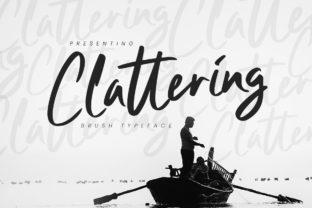
Clattering isn’t just another brush font—it’s a tactile, expressive voice on the page. Designed as a handmade brush typeface, Clattering balances thick, assertive strokes with fluid, thin curves in a way that feels both intentional and alive. It doesn’t sit quietly in the background. It leans in, speaks up, and carries presence—without sacrificing readability or warmth. If you’ve ever scrolled past dozens of “handwritten” fonts only to find them either too stiff or too chaotic, Clattering lands right in the sweet spot: free-flowing enough to feel human, bold enough to hold attention.
Where Clattering Fits Naturally—Not Just Where It *Looks* Good
Clattering shines brightest when authenticity and impact matter more than perfection. Think about the last time you saw a small-batch coffee bag with hand-brushed lettering—or a boutique skincare label where the name seemed to breathe with the product’s personality. That’s Clattering’s natural habitat: physical, tangible, human-centered design.
It works especially well for:
- Local food & beverage brands—a craft brewery’s limited-release can, a neighborhood bakery’s seasonal menu board, or a cold-pressed juice label. Clattering’s confident curves echo the care behind small-batch production, while its handmade texture reinforces artisanal credibility.
- Creative studios & independent designers—as a signature accent for logo lockups, portfolio headers, or social media story text. Because it’s bold but not aggressive, it adds distinction without overwhelming supporting typography (like a clean sans-serif body font).
- Event branding with soul—think wedding invitations where couples want elegance *and* personality, or a music festival poster that needs to feel energetic but not generic. Clattering’s rhythm mimics the cadence of spoken language—making headlines feel like they’re being announced, not just displayed.
- Educational and wellness spaces—yoga studio newsletters, mindfulness course titles, or workshop handouts. Its organic variation in stroke weight subtly conveys breath, movement, and groundedness—qualities people actively seek in those contexts.
Who Benefits—and How Their Needs Shape the Choice
A freelance graphic designer working with a new client might reach for Clattering not because it’s trendy, but because it solves a real problem: helping a brand stand out in crowded digital feeds *without* resorting to overused script fonts or sterile geometric caps. Its contrast is high enough to catch the eye in thumbnail size, yet its curves soften the visual impact—making it more approachable than ultra-bold display fonts.
For a solo entrepreneur launching an online shop—say, handmade ceramics or botanical candles—Clattering becomes part of the brand’s first impression. Used sparingly on packaging seals, website banners, or Instagram highlights, it signals craftsmanship before a single product photo loads. It tells customers, “This wasn’t mass-produced. Someone held a brush—and meant it.”
Teachers and community organizers also find quiet utility in Clattering. A school newsletter header set in Clattering feels more inviting than standard fonts—less institutional, more collaborative. A neighborhood garden project flyer gains warmth and local character without needing custom illustration. It’s subtle influence, not loud decoration.
What to Keep in Mind Before You Use It
Clattering is expressive—but expression has context. It’s not built for long paragraphs, fine print, or interfaces demanding maximum legibility at small sizes. That’s not a flaw; it’s by design. Like choosing the right tool for a job, knowing when *not* to use Clattering is just as important as knowing when to reach for it.
Consider these practical realities:
- Scale matters: At 24pt and above, Clattering’s confidence and nuance shine. Below 16pt, some of its thinner curves begin to lose definition—especially on low-resolution screens or printed materials with tight ink spread. Reserve it for headings, logos, quotes, and short callouts—not body copy or data tables.
- Pairing is key: Clattering thrives alongside neutral, well-spaced sans-serifs (think Inter, Poppins, or even Helvetica Neue) or gentle serifs like Merriweather or Lora. Avoid pairing it with other highly decorative or tightly spaced fonts—they’ll compete instead of complement.
- Color contrast affects tone: In deep navy or charcoal on cream, Clattering feels grounded and timeless. In bright coral or electric yellow on black, it pulses with energy—ideal for youth-oriented campaigns or pop-up events. But avoid light gray on white; its delicate thin strokes will vanish.
- File format & rendering: As a variable or OpenType font, Clattering renders cleanly across modern browsers and design apps. However, older PDF workflows or basic email clients may substitute fallback fonts if embedded improperly. Always test export previews—and when in doubt, convert headlines to outlines for final print files.
Strengths That Solve Real Problems
Clattering’s biggest strength isn’t just how it looks—it’s how it helps users communicate *intention*. In a world saturated with algorithmically optimized, frictionless design, Clattering reintroduces welcome friction: the kind that says, “This was made by hand, for people.” Its bold-thin contrast creates natural visual hierarchy without relying on size alone. Its irregularity invites pause—not confusion. And because it’s handmade (not digitally generated), it avoids the uncanny valley of “almost-human” scripts that feel eerily uniform.
It also scales gracefully across mediums. A Clattering headline on a website translates meaningfully to a vinyl banner at a farmers’ market. A logo using Clattering holds up on a tiny embroidered patch and a large mural wall. That versatility saves time—and builds consistency—across touchpoints where many fonts falter.
When Another Font Might Be a Better Fit
Clattering isn’t the answer for every bold or expressive need. If your project demands strict typographic neutrality (like a government health campaign or legal documentation), its personality could distract from clarity. If you need multilingual support—including extended Latin, Cyrillic, or diacritics beyond basic accented characters—check the specific Clattering version you’re using; some releases prioritize English-language use cases first.
And while its confidence is a strength, it can unintentionally read as informal in certain corporate or academic settings—especially if used without thoughtful context or supporting design cues. A university research initiative might choose Clattering for a public-facing community engagement campaign, but likely opt for something more restrained in formal grant proposals.
In short: Clattering earns its place when the goal is connection, character, and quiet confidence—not when the priority is invisibility, universality, or precision at micro-scales. It’s the font you choose when you want people to feel something *before* they even read the words.