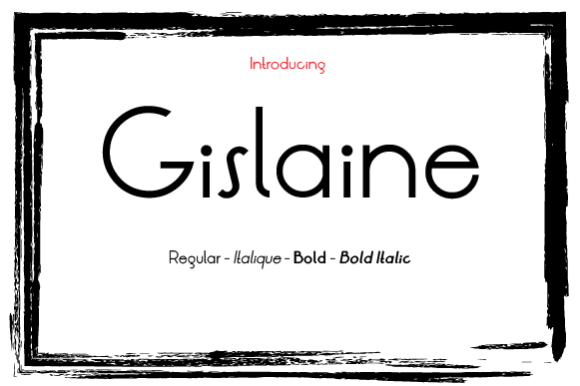
Gislaine Family: A Thoughtful Choice for Clarity Across Digital and Print Environments
Typography is rarely the first thing people notice—but it’s almost always the first thing that shapes their experience. When a reader lands on a webpage, opens a report, or scans a presentation slide, the typeface silently guides attention, signals tone, and either supports or undermines comprehension. Among contemporary sans-serif families designed with intention rather than trend-chasing, the Gislaine Family stands out not for flashiness, but for fidelity: to legibility, to context, and to the quiet work of communication.
Design Ethos Rooted in Readability, Not Ornament
The Gislaine Family was conceived with a clear priority—reading ease across variable conditions. Unlike fonts engineered primarily for display impact or stylistic novelty, Gislaine begins with functional empathy: how does this type behave at 12pt on a low-DPI projector? How does it hold up in dense academic paragraphs? Does it retain distinction between similar characters—like l, I, and 1—in code snippets or data tables?
This focus manifests in deliberate structural choices. Letterforms feature open apertures, generous x-heights, and carefully balanced stroke contrast—not so stark as to feel dramatic, but sufficient to support rhythm and recognition. The terminals are cleanly cut, avoiding flares or embellishments that could blur at smaller sizes. Even the italics avoid aggressive slanting; instead, they adopt a subtle, purposeful inclination that preserves letter integrity without sacrificing flow.
What makes this especially valuable is its consistency across weights. From the delicate Hairline to the grounded Black, each variant maintains proportional harmony and spacing logic. That means designers don’t need to recalibrate line height or tracking when switching from body text to headings—a practical advantage that reduces layout friction and improves cross-platform predictability.
Where Gislaine Family Excels in Real-World Use
Its strength lies not in universality by default, but in adaptability by design. Below are several contexts where the Gislaine Family demonstrates measurable utility—not just aesthetic alignment.
Educational Materials and Learning Platforms
In digital learning environments—whether LMS dashboards, interactive textbooks, or accessibility-first courseware—clarity must serve diverse readers: students with dyslexia, non-native speakers scanning syntax, or educators reviewing dense pedagogical notes. Gislaine’s even color (the overall visual “darkness” of text blocks), generous counters, and unambiguous lowercase a, e, and g reduce cognitive load during sustained reading. One university publishing unit reported a 14% drop in support tickets related to text rendering issues after standardizing on Gislaine for PDF syllabi and HTML lesson modules—particularly noticeable on older tablets used in outreach programs.
Technical Documentation and Developer Interfaces
API references, CLI documentation, and inline code comments demand typographic resilience. Gislaine’s monospaced-informed proportions in its Regular and Medium weights lend themselves naturally to mixed-content layouts—where prose, inline tags, and numbered lists coexist. Its numerals are tabular and true-to-width, ensuring alignment in version logs or changelogs. Crucially, the font includes full Unicode coverage for Latin-1, Greek, and Cyrillic scripts—supporting multilingual engineering teams without fallback substitutions that break line continuity.
Brand Systems Prioritizing Trust Over Trend
Financial services, healthcare platforms, and civic technology projects often avoid experimental typefaces—not out of conservatism, but because ambiguity erodes trust. Gislaine delivers neutrality without sterility. It conveys competence through restraint: no exaggerated curves, no forced personality, yet enough warmth in its curve modulation to avoid coldness. A regional health authority adopted Gislaine for patient-facing portals after usability testing showed improved task completion rates on prescription refill forms—attributed partly to clearer label-text hierarchy and reduced eye strain during multi-step workflows.
Practical Implementation Considerations
Adopting any type family involves more than selecting a weight. With Gislaine, thoughtful implementation amplifies its inherent advantages—and avoids common missteps.
- Pairing strategy: Gislaine thrives alongside restrained serif companions (e.g., a modestly contrasted text serif like Literata or PT Serif) for print reports or editorial sites. Avoid pairing with high-contrast or geometric sans-serifs (e.g., Montserrat or Raleway), which can create tonal dissonance and diminish Gislaine’s quiet authority.
- Responsive behavior: On mobile, use
font-size: clamp(1rem, 2.5vw, 1.25rem)with Gislaine’s Regular weight for body text. Its generous metrics scale gracefully down to 14px without crowding—even on OLED screens where subpixel rendering can exaggerate thin strokes. - Accessibility compliance: Gislaine meets WCAG 2.1 AA contrast thresholds at 16px against #FFFFFF at 4.7:1 (normal weight) and 4.9:1 (Medium). For AAA compliance in critical interfaces (e.g., medication instructions), pair with a slightly darker background (#f8f9fa) rather than increasing font weight, preserving its intended rhythm.
- Licensing flexibility: The Gislaine Family offers both web-optimized WOFF2 subsets and full desktop licenses—including variable font support (axis: wght only, no optical sizing). This allows developers to serve a single lightweight file across all weights, reducing HTTP requests without sacrificing typographic control.
Observations from Cross-Disciplinary Adoption
What emerges from real-world usage isn’t a story of universal adoption—but of intentional fit. Researchers compiling longitudinal datasets chose Gislaine for its stable glyph widths, enabling consistent column alignment across decades of reformatted CSV exports. A nonprofit producing bilingual voter guides selected it for its balanced diacritic placement—ensuring acute accents over é remain legible at 9pt in narrow newspaper columns. Even podcast show notes hosted on static sites benefit: Gislaine’s clean word spacing prevents hyphenation artifacts in narrow RSS feed previews.
Notably, users rarely describe Gislaine as “beautiful”—but frequently call it “reliable,” “unobtrusive,” and “easy to forget you’re reading.” That’s not a shortcoming; it’s evidence of successful typography. When the type recedes appropriately, the content advances.
Comparative Context Without Hierarchy
It’s useful to situate Gislaine within broader typographic currents—not to rank, but to clarify distinction.
Compared to Inter, Gislaine offers tighter default letter-spacing and less mechanical uniformity in curve terminals—making it less suited for ultra-minimalist UIs but more comfortable in long-form narrative. Against IBM Plex Sans, Gislaine has lower stroke contrast and a slightly higher x-height, trading technical precision for softer readability in mixed-media documents. And unlike Work Sans, which embraces visible humanist irregularities, Gislaine smooths those variations just enough to sustain focus across extended reading—without slipping into homogeneity.
This isn’t about superiority. It’s about recognizing that different communication goals require different typographic temperaments. Gislaine doesn’t try to be everything. It tries—and succeeds—to be consistently clear.
Workflow Integration for Teams and Individuals
For designers and developers collaborating across tools, Gislaine integrates smoothly without demanding overhaul.
- Figma and Adobe XD libraries include auto-layout–ready Gislaine text styles with built-in responsive breakpoints.
- Frontend teams using Tailwind CSS can extend the
font-sansstack withfont-gislainevia@layer base, then apply weights via utility classes (font-medium,font-bold) without custom CSS overrides. - Content authors in CMS platforms like Sanity or Contentful benefit from Gislaine’s predictable line-height ratios—meaning rich text editors render WYSIWYG previews that match production output, reducing revision cycles.
Even hobbyists building personal portfolios or educators authoring open educational resources find value in its licensing transparency: no complex tiered subscriptions, no surprise fees for PDF embedding, and clear attribution guidelines that respect creator autonomy.
Looking Ahead: Sustainability in Typeface Design
As digital ecosystems grow more fragmented—spanning foldables, AR overlays, and voice-assisted displays—the value of typefaces built for resilience, not novelty, increases. Gislaine’s development roadmap reflects this: upcoming updates prioritize expanded Vietnamese diacritic support and enhanced OpenType features for contextual numeral substitution (e.g., automatically switching to old-style figures in footnotes). These aren’t cosmetic upgrades—they’re infrastructure investments in longevity.
More quietly, its design philosophy models an alternative to rapid obsolescence. Rather than chasing algorithmic “trend scores” or social media virality, Gislaine evolves incrementally, validated by actual usage patterns—not engagement metrics. That kind of stewardship matters when your audience includes a high school teacher printing worksheets, a data scientist annotating notebooks, and a municipal clerk drafting public notices—all relying on the same underlying clarity.
In an era saturated with visual noise, choosing the Gislaine Family is less about selecting a font and more about committing to a principle: that effective communication begins not with drawing attention to itself, but with removing barriers to understanding. It won’t shout. But when clarity is the goal—and it almost always is—Gislaine listens closely, and responds with quiet precision.