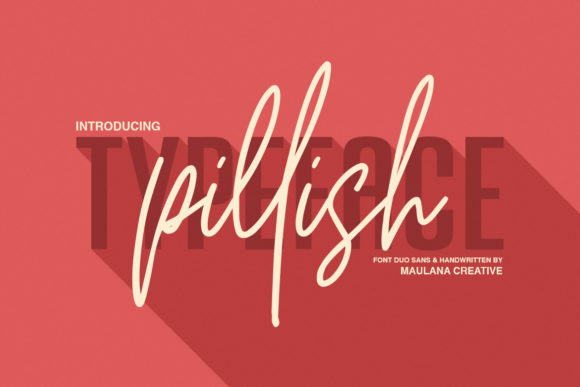
Pillish Duo: A Playful Sans + Elegant Script
If you’ve ever stared at a blank layout wondering how to make it feel both joyful and intentional, Pillish Duo might be the quiet solution you’ve been missing. It’s not another “trendy” font bundle—it’s a thoughtfully balanced pair: a friendly, rounded sans serif that breathes ease into headlines and UI elements, and a graceful, slightly bouncy script that adds warmth without sacrificing legibility. Together, they form a rare kind of harmony—where approachability meets polish, and personality doesn’t come at the cost of professionalism.
What Makes This Duo Feel So Natural?
The sans half of Pillish Duo has soft terminals, open counters, and just enough variation in stroke weight to feel human—not mechanical. It’s not minimalist to the point of sterility, nor is it overly decorative. Think of it as the kind of typeface you’d trust for a café menu, a workshop flyer, or a product label where clarity matters but charm matters more. It’s a display font that works equally well at 24px on a mobile screen or 72pt on a poster.
The script half moves with gentle rhythm—no sharp angles or aggressive flourishes. Its lowercase letters connect smoothly, but it’s not so cursive that it becomes hard to scan. You’ll notice subtle contrast between thick downstrokes and thin upstrokes, giving it presence without drama. It reads like handwriting from someone who’s confident but unhurried—ideal for quotes, signatures, short brand taglines, or accent text in editorial layouts.
What sets Pillish Duo apart isn’t just how each font looks alone—it’s how they behave *together*. The x-heights align closely. The weights complement rather than compete. And crucially, neither one shouts over the other. That balance means you can use them side-by-side in a logo lockup, layer them in social media banners, or alternate them across a multi-page zine without visual whiplash.
Where Pillish Duo Earns Its Keep
This duo shines brightest where authenticity and readability intersect. Small business owners use it for packaging design—say, a line of organic skincare where the sans names the product (“Lavender Calm Serum”) and the script adds the tagline (“crafted with care”). Bloggers and content creators apply it in newsletter headers and Instagram story templates: clean sans for the subject line, script for the personal sign-off (“—Alex”). Crafters print greeting cards with the script as the greeting (“Hello, friend!”) and the sans for practical details (date, location, RSVP info).
In web design, the sans works reliably as a system font alternative—especially in hero sections or CTA buttons—while the script adds texture in testimonials or feature highlights. For publishers building digital magazines or printed chapbooks, Pillish Duo supports strong visual hierarchy: sans for section titles and pull quotes, script for author bylines or chapter dividers. Even in logo design, the pairing avoids cliché—the script brings character, the sans grounds it in credibility.
It’s less suited for long-form body copy (neither font includes extensive OpenType features like small caps or true italics), and it won’t replace a robust serif font in dense academic publishing. But as a creative font for branding assets, social graphics, merch, event invites, or even podcast cover art? It delivers consistent, recognizable tone with minimal effort.
Testing Fit Before You Commit
Before licensing Pillish Duo, ask yourself two things: *What emotion do I want this project to convey?* and *Where will people actually read it?* If your answer leans toward “friendly but thoughtful,” “modern but warm,” or “creative but grounded,” it’s likely a fit. If you need high-contrast authority (like a law firm website) or ultra-minimalist precision (a tech dashboard), look elsewhere.
Test early. Drop both fonts into a mockup at real sizes: 16px for mobile body text (use the sans only here), 36–48px for desktop headers, and 20–28px for script accents. Check contrast against your background colors—especially with the script, which relies on clear separation to remain legible. Also verify spacing: some script fonts collapse awkwardly at tight tracking; Pillish Duo holds its shape well, but always preview at final export size.
Review what’s included. Most versions of Pillish Duo ship with regular and bold weights for the sans, and one script style (often with alternate characters accessible via OpenType features). No condensed or light variants—but that’s intentional. It’s a focused tool, not an exhaustive family. If your project needs five weights and three widths, this isn’t the commercial font for you. But if you value cohesion over complexity, it’s refreshingly direct.
Licensing, Legibility, and Long-Term Use
Pillish Duo is a premium font—meaning it’s designed and supported by professionals, and its commercial license covers most common uses: websites (with proper @font-face setup), client work, merchandise, apps, and even SaaS platforms—as long as you’re not redistributing the font files themselves. Always check the specific license terms before embedding in a public-facing product, but for freelancers and small studios, it’s typically straightforward.
Legibility isn’t just about letterforms—it’s about context. The script reads beautifully on matte paper or soft digital backdrops, but avoid placing it over busy photos or low-contrast gradients. The sans handles those scenarios better, especially with generous letter-spacing. In practice, many designers use the sans exclusively for accessibility-critical text (like form labels or navigation), then bring in the script for moments that benefit from expressive emphasis.
Over time, consistent use of Pillish Duo builds recognition—not because it’s flashy, but because it’s dependable. When your audience sees that gentle curve in the script “P” or the friendly roundness of the sans “o,” it starts to signal something familiar: your voice, your values, your attention to detail. That’s how type becomes part of brand identity—not through novelty, but through repetition with intention.