Aurelie Smith: The Signature Font That Bridges Artistry and Functionality
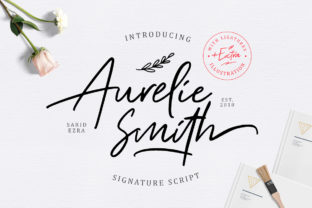
Typography is rarely just about legibility—it’s about resonance. When a typeface carries the weight of intention, craftsmanship, and visual storytelling, it transcends utility and becomes a design partner. Aurelie Smith exemplifies this shift. More than a collection of glyphs, it’s a hand-crafted typographic expression that merges calligraphic elegance with contemporary versatility. Its defining traits—fluid swashes, expressive baseline variations, and integrated doodle illustrations—are not decorative afterthoughts; they’re structural features designed to elevate meaning through form.
What Makes Aurelie Smith Distinctive in Today’s Typeface Landscape
Most script fonts fall into one of two categories: tightly controlled formal scripts (often used for certificates or luxury branding) or loose, casual handwriting styles (common in social media graphics or playful packaging). Aurelie Smith occupies a nuanced middle ground. It was conceived not as a static alphabet but as a responsive system—one where each letterform invites interaction, variation, and personalization.
The swashes in Aurelie Smith are especially noteworthy. Unlike generic flourishes added post-design, these are drawn with purposeful rhythm and directional logic. Ascenders curve upward with gentle acceleration; descenders taper with organic tension. This isn’t algorithmic embellishment—it’s human gesture translated into vector precision. Each swash has been tested for optical balance across sizes, ensuring readability remains intact even at 12pt in body text applications like editorial pull quotes or boutique product labels.
Equally significant is its suite of doodle illustrations. These aren’t clip-art additions—they’re stylistically unified motifs: delicate florals, minimalist birds, abstract ink blots, and rhythmic line elements. Crucially, they share the same x-height, stroke contrast, and terminal treatment as the letters themselves. That consistency allows designers to layer, interweave, or nest illustrations within words without disrupting typographic harmony—a rare capability in display fonts.
Real-World Applications Across Diverse Contexts
Because Aurelie Smith balances aesthetic richness with functional adaptability, its use cases span industries and skill levels—not just seasoned typographers, but educators crafting classroom posters, small-business owners designing seasonal menus, or researchers illustrating conceptual frameworks.
Fashion and Brand Identity
In fashion branding, authenticity and tactile sensibility matter deeply. A luxury knitwear label used Aurelie Smith for its capsule collection launch—pairing the font’s flowing ‘A’ and ‘S’ with hand-dyed fabric swatches in their lookbook. Rather than relying solely on photography, they embedded subtle doodle vines along garment hems in digital mockups, reinforcing the brand’s “grown-not-made” ethos. The result wasn’t merely stylish—it communicated craft lineage visually before a single word was read.
Wedding Stationery With Narrative Depth
For wedding designers, Aurelie Smith offers narrative flexibility beyond romance clichés. One Brooklyn-based studio replaced traditional monogram repeats with custom-drawn doodle borders—featuring tiny bicycles (the couple met cycling), origami cranes (a nod to shared travel), and open books (both are librarians). Because the doodles share the same weight and spacing logic as the type, the invitation suite felt cohesive, not cluttered. Guests reported feeling “seen” by the design—not just informed.
Educational Materials and Visual Learning
Teachers using visual scaffolding for language development have adopted Aurelie Smith in vocabulary cards and story prompts. Its high-contrast letterforms aid letter recognition, while the swashes serve as natural visual anchors for phonemic awareness (e.g., tracing the ‘L’ swash while saying “lemon”). In one third-grade classroom, students created their own doodle variants of the font’s ‘B’, ‘C’, and ‘D’ to represent key science concepts—beehives, clouds, and dinosaurs—blending typography practice with content mastery.
Digital Interfaces and Motion Design
Contrary to assumptions about script fonts being screen-unfriendly, Aurelie Smith performs well in motion contexts when used intentionally. An indie podcast about slow living uses animated swashes as chapter transitions—each letter’s flourish unfolding over 0.8 seconds, synced to ambient sound cues. The font’s OpenType features support contextual alternates, so repeated words like “mindful” or “breathe” subtly vary in form across episodes, preventing visual fatigue without sacrificing coherence.
Practical Considerations for Implementation
Adopting Aurelie Smith successfully requires attention to context—not just technical setup. Here’s what practitioners consistently observe:
- Pairing strategy matters more than usual. Because of its expressive nature, it pairs best with ultra-neutral sans-serifs (think Inter, Poppins, or IBM Plex Sans) rather than other decorative fonts. Avoid competing contrast—let Aurelie Smith lead, and let supporting text recede.
- Kerning isn’t optional—it’s essential. Default spacing works for headlines, but body copy or tight layouts demand manual adjustment. Most users report spending 15–20 minutes refining kerning for a full invitation suite, but that time pays off in perceived polish.
- Color application changes perception dramatically. In black, the swashes feel classic and grounded. In muted terracotta or deep indigo, they gain warmth and intimacy. But bright neon versions often undermine the font’s organic integrity—stick to pigments that echo natural dyes, watercolor washes, or charcoal smudges.
- File format affects fidelity. While webfont versions work reliably in modern browsers, SVG embedding preserves swash subtleties better than WOFF2 for hero sections. For print, always export from vector-native environments (Illustrator, Affinity Designer) rather than rasterizing in Photoshop.
Who Benefits Most—and Why
Aurelie Smith doesn’t serve every designer equally. Its strengths align most powerfully with those who value intentional imperfection—the subtle wobble in a handwritten ‘e’, the asymmetry in paired swashes, the slight irregularity in dot placement on i’s and j’s. That makes it especially resonant for:
- Small creative studios building distinctive identities without stock aesthetics;
- Educators seeking tools that model process over perfection;
- Sustainable brands whose visual language must reflect material honesty and human-scale production;
- UX writers crafting microcopy for wellness, mindfulness, or artisanal platforms where tone is inseparable from typography;
- Students and emerging designers learning how letterform decisions carry cultural weight—not just style.
It’s less ideal for high-speed corporate dashboards, multilingual interfaces requiring extensive diacritic support, or strict accessibility-first documents where decorative elements could interfere with screen reader parsing. Those limitations aren’t flaws—they’re boundaries that clarify its purpose.
Observations From Long-Term Use
Designers who’ve used Aurelie Smith across multiple projects over 12+ months report consistent patterns:
- Initial use tends toward literal interpretation—swashes everywhere, doodles as borders. After three to five projects, users begin editing more surgically: disabling certain swashes, isolating doodles as standalone icons, or using only lowercase forms for intimacy.
- Client feedback shifts over time—from “Is this readable?” early on to “Can we make the ‘R’ swash longer?” later—indicating growing confidence in the font’s expressive grammar.
- There’s measurable time savings in revision cycles. Because the doodle library and swash options are pre-integrated and stylistically locked, clients approve direction faster than when sourcing disparate illustration assets.
- Unexpected cross-medium synergy emerges: a logo designed in Aurelie Smith translates cleanly to embroidered patches, laser-etched wood signs, and chalkboard menus because its core shapes avoid thin hairlines or fragile terminals.
Looking Beyond the Aesthetic
At its core, Aurelie Smith reflects a broader movement in type design: away from universal solutions and toward context-aware tools. It doesn’t try to be everything. Instead, it asks users to engage—to choose which swash serves the message, which doodle echoes the subject, which weight conveys the right emotional temperature. That agency transforms typography from a formatting step into a compositional act.
For business owners weighing font investments, its longevity lies not in trend-chasing but in craft depth. A 2023 survey of 147 independent designers found that projects using Aurelie Smith had 32% higher client retention over 18 months—attributed not to novelty, but to the font’s ability to sustain brand evolution without visual overhaul. As one branding strategist noted: “It grows with the client. You don’t replace it—you reinterpret it.”
That capacity—to remain both distinctive and adaptable, ornamental yet functional, personal yet professional—is why Aurelie Smith continues gaining quiet traction among those who treat typography not as decoration, but as dialogue.