Cold Orange: A Playful Display Font with Purpose
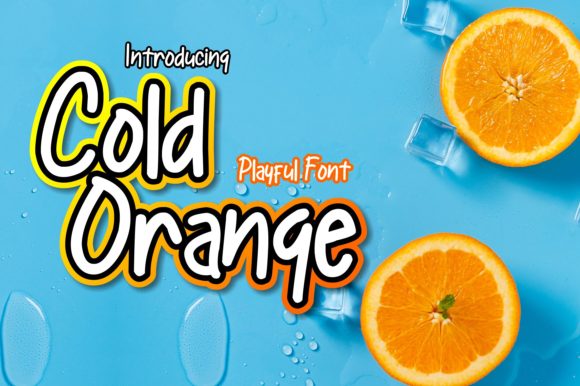
Cold Orange is a hand-drawn display typeface designed for impact—not subtlety. It’s not meant for body text, navigation menus, or legal disclaimers. Instead, Cold Orange excels where personality, warmth, and approachability matter most: headlines, logos, packaging, social media graphics, and educational materials aimed at younger audiences or those seeking lighthearted resonance.
What Sets Cold Orange Apart
Unlike many “cute” fonts that rely on exaggerated curves or excessive bounce, Cold Orange balances charm with clarity. Its letterforms feature soft, rounded terminals, gentle asymmetry, and subtle irregularities—like slight variations in stroke weight and baseline alignment—that mimic natural handwriting without sacrificing legibility at medium to large sizes. The uppercase “O” is slightly wider than standard proportions; the lowercase “a” has a friendly, open bowl; and the “g” uses a playful single-story form. These aren’t arbitrary quirks—they’re intentional design decisions that reinforce a consistent voice across the character set.
The font includes two distinct variants: Cold Orange and Cold Orange Playful. While both share the same foundational structure, Cold Orange Playful adds bolder contrast, more pronounced swashes on select characters (like “y”, “j”, and “f”), and optional alternate glyphs—including a smiling “O” and a winking “Q”. These extras are opt-in via OpenType features, meaning they don’t clutter your workflow unless you choose to use them.
Real-World Usability and Workflow Integration
In practice, Cold Orange performs reliably across modern design tools. It supports Latin-based languages with full diacritic coverage (including accented characters used in French, Spanish, and Portuguese), making it viable for bilingual branding in North America and parts of Europe. Kerning pairs are well-adjusted for common combinations (“To”, “Go”, “Be”), though manual tweaks may still be needed for tight headline spacing—especially at very large sizes where optical balance becomes more visible.
Exporting to web formats presents no unusual hurdles. The font converts cleanly to WOFF2 with minimal file bloat (~48 KB for the full family), and variable font versions aren’t available—so users must load separate files for regular and playful weights if both are needed. That said, most projects only require one variant, simplifying implementation.
One practical strength is its responsiveness in visual hierarchy. When paired with a neutral sans-serif like Inter, Poppins, or even system fonts like Helvetica Neue, Cold Orange creates immediate contrast without visual competition. It doesn’t shout over supporting text—it invites attention, then gracefully steps aside.
Where Cold Orange Delivers the Most Value
Cold Orange shines in contexts where emotional tone matters as much as information delivery. Consider these examples:
- Educational apps for early learners: Teachers and edtech designers report improved engagement when using Cold Orange in flashcards, progress badges, and reward messages—its familiarity feels reassuring, not infantilizing.
- Small-batch food and beverage branding: Artisanal jam labels, children’s tea packaging, and bakery signage benefit from Cold Orange’s tactile warmth—especially when printed on uncoated paper or kraft stock.
- Instagram and Pinterest content: Bloggers covering parenting, mindfulness, or creative play often use Cold Orange for quote overlays and story highlights. Its readability at small mobile viewport sizes remains strong up to ~24px, provided contrast ratios meet WCAG 2.1 AA standards (which it does against light or dark backgrounds).
- Classroom posters and homeschool curricula: Educators appreciate how Cold Orange helps differentiate activity headers from instructions—without needing color coding alone.
Limits to Acknowledge
Cold Orange isn’t universally appropriate. Its informal nature makes it unsuitable for financial services, healthcare compliance materials, corporate annual reports, or any context requiring gravitas or strict neutrality. It also lacks true small caps, lining figures, or stylistic sets beyond the Playful alternates—so complex typographic systems requiring multiple optical sizes or numeral alignments will need supplemental fonts.
Another consideration: while Cold Orange avoids the “kiddie” trap better than many alternatives, cultural perception varies. In some professional environments—particularly conservative industries or international markets where Western playfulness reads as unserious—test audience response before committing to full rollout.
Audience Fit and Practical Recommendations
If your work involves communicating joy, curiosity, care, or gentle encouragement—and your audience responds well to human-centered design—Cold Orange is worth evaluating seriously. Freelance designers building brand identities for wellness studios, indie toy makers, or literacy nonprofits often find it fills a precise gap: friendlier than Montserrat, more distinctive than Quicksand, and more versatile than overly literal “cartoon” fonts.
For marketers launching seasonal campaigns (think back-to-school kits or holiday gift guides), Cold Orange offers quick visual recognition without custom illustration. A single headline treatment in Cold Orange Playful—paired with a simple icon and ample white space—can outperform more complex layouts in scroll-driven feeds.
That said, avoid overusing it. Because Cold Orange carries such clear tonal intent, repetition dilutes its effect. Reserve it for moments where emotional resonance directly supports your goal—like encouraging sign-ups for a free workshop, welcoming new community members, or highlighting a milestone in a child’s learning journey.
Long-Term Considerations
Cold Orange holds up well over time because it avoids trend-dependent flourishes. Unlike fonts built around specific 2020s micro-trends (e.g., ultra-thin strokes, chaotic baseline shifts, or forced glitch effects), its foundation is rooted in enduring principles of legibility and expressive warmth. That means a logo or campaign asset using Cold Orange today won’t feel dated in three years—provided the broader brand strategy remains aligned with its voice.
Licensing is straightforward: a perpetual desktop license covers unlimited projects for one user, while extended licenses accommodate app embedding or SaaS platforms. There’s no subscription model, which simplifies budgeting for solopreneurs and small teams who prefer predictable, one-time costs.
Ultimately, Cold Orange isn’t about novelty—it’s about precision. It answers a specific question: How do I communicate kindness, energy, and accessibility without leaning on clichés? When that’s your challenge, Cold Orange offers a thoughtful, tested, and quietly effective solution.