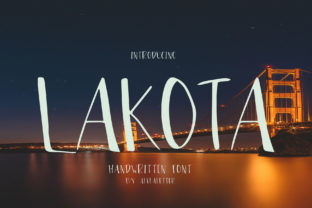
LAKOTA: A Bold Handwritten Display Font
If you’ve ever scrolled past a social media ad, a craft fair banner, or a boutique coffee bag and paused—just for a second—because the headline felt alive, warm, and unmistakably human, there’s a good chance Lakota was behind it. Lakota isn’t just another handwritten font. It’s all-caps, deliberately imperfect, and built with the weight and rhythm of ink pressed firmly onto paper. Its letters have subtle variations in stroke thickness, slight irregularities in baseline alignment, and confident, unapologetic angles—like something sketched by hand, then refined for clarity and impact.
Where Lakota Fits—and Why It Stands Out
Lakota is a premium display font—not meant for paragraphs or body text, but for moments that need to land. Think logo design for a local ceramics studio, bold headlines on a food blog’s homepage, or the word “FRESH” stamped across a farmers’ market tote bag. Its personality sits at the intersection of approachable and authoritative: friendly enough for a handmade soap label, strong enough for a streetwear brand’s capsule collection drop.
Unlike delicate script fonts or tightly kerned sans serifs, Lakota carries presence without shouting. It doesn’t mimic calligraphy—it owns its own voice. That makes it especially useful in editorial design (magazine covers, newsletter headers), packaging design (canned sauces, small-batch candles), and social media graphics where visual hierarchy matters more than fine detail. On mobile screens, Lakota holds up well at larger sizes because its shapes are open, legible, and grounded—not overly condensed or fussy.
Real-World Impact on Brand Perception
Typography quietly shapes how people feel about your work before they read a single word. Lakota signals authenticity and intention. When used thoughtfully—say, as the only type element in a minimalist logo—it tells your audience: *This wasn’t automated. This was chosen.* That builds trust, especially among audiences who value craft, sustainability, or independent makers.
But Lakota also demands context. Slapping it over a stock photo of a corporate boardroom feels off. It thrives where warmth, individuality, or tactile energy align with your message—like a bakery’s Instagram story announcing weekend sourdough drops, or a podcast cover highlighting candid, conversational interviews. Used consistently across touchpoints (website banner, email header, sticker sheet), it becomes part of your brand identity—not just decoration.
Readability & Practical Use Considerations
Lakota is not a workhorse font. It’s a spotlight font. Never use it below 24pt in print or 32px on screen—and even then, test it with real users. Small sizes blur its character and reduce legibility, especially for readers with visual impairments or those scanning quickly on mobile. Its all-caps structure helps with recognition at a glance, but avoid long lines or dense blocks. One or two words? Perfect. A full sentence? Reconsider.
Also note: Lakota is a single-style font—no italics, no bold variants, no light weights. What you get is one confident, cohesive all-caps cut. That simplicity is a strength (it avoids visual clutter), but it means pairing becomes essential. You’ll want a clean, neutral companion—like a well-proportioned sans serif (e.g., Inter, Poppins, or Montserrat) for supporting text. Avoid other handwritten or decorative fonts nearby; Lakota needs breathing room to shine.
How to Choose—and When to Pass
Before licensing Lakota, ask three questions:
- Does this project benefit from human warmth over digital precision? If your goal is clinical clarity (a medical device manual, legal disclaimer), skip it.
- Is the usage large-scale and intentional? A 60pt logo lockup? Yes. A 14pt caption under an Instagram post? No.
- Do you have control over color, contrast, and background? Lakota needs contrast—light text on dark backgrounds works, but avoid low-contrast combos like grey-on-grey or yellow-on-cream.
Test it early. Drop Lakota into your mockup next to your actual content—not placeholder lorem ipsum. Does “OPEN DAILY” feel inviting on your café’s window decal? Does “HANDMADE IN OREGON” reinforce credibility on your pottery website? If yes, it’s likely a fit. If it feels forced or fights your imagery, keep looking.
Licensing & Commercial Realities
Lakota is a commercial font, meaning personal use (like a birthday card for a friend) may be free or low-cost, but using it in client work, product packaging, or branded merchandise requires a proper license. Always check the foundry’s terms—some include web font hosting, app embedding, or unlimited impressions; others limit usage by revenue or distribution volume. Never assume “free download = free for business.” Misusing fonts risks takedowns, legal notices, or damaged credibility—especially if a client discovers you used an unlicensed asset in their brand identity.
Also worth noting: Lakota does not include extended language support beyond basic Latin characters (A–Z, numerals, common punctuation). If your project targets multilingual audiences—say, Spanish-speaking customers in Texas or French Canadian markets—you’ll need fallbacks or complementary fonts for non-English text.
Pairing Lakota Thoughtfully
Good font pairing isn’t about contrast for contrast’s sake—it’s about harmony and function. With Lakota, aim for balance: let it command attention, then step back with something calm and functional. Try these pairings in real projects:
- A tight, modern sans serif (like Manrope or DM Sans) for body copy beneath a Lakota headline—clean, readable, and respectful of Lakota’s personality.
- A gentle, low-contrast serif (like IBM Plex Serif or Cormorant Garamond) for editorial layouts where Lakota anchors section titles and serif handles narrative flow.
- A monospace for technical details (ingredients, specs, timestamps)—the starkness creates useful tension without competing.
Avoid pairing Lakota with other all-caps fonts, ultra-thin typefaces, or anything with heavy ornamentation. The goal is to let Lakota breathe—not compete.
In short: Lakota earns its place when you need authenticity with authority, charm with clarity, and handwriting with intention. It won’t solve weak messaging—but in the right hands, at the right scale, and with the right context, it becomes more than a font. It becomes a quiet signature of care.