Eucalyptus Spearmint
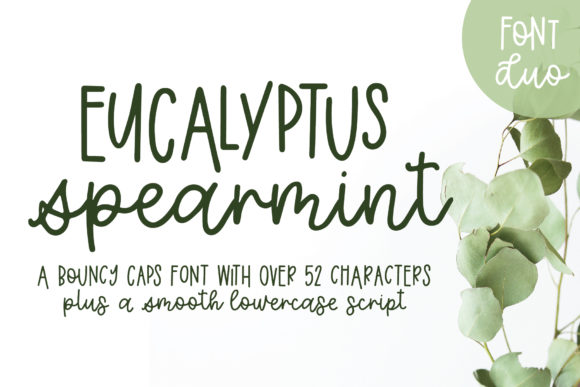
Eucalyptus Spearmint is a contemporary sans serif typeface designed with expressive versatility in mind. It balances soft, rounded forms with subtle structural confidence—neither overly formal nor strictly playful—making it adaptable across contexts where tone matters but rigidity does not. Its name reflects its dual character: “Eucalyptus” evokes freshness and clarity; “Spearmint” suggests lightness and gentle energy. This isn’t a display-only novelty font, nor is it a neutral workhorse like Helvetica or Inter. Instead, Eucalyptus Spearmint occupies a thoughtful middle ground—romantic and sweet in spirit, yet casual enough for everyday use.
Designers, crafters, and small business owners often seek fonts that communicate warmth without sacrificing legibility or professionalism. Eucalyptus Spearmint responds to that need by offering stylistic richness without demanding technical expertise. Its PUA (Private Use Area) encoding means all alternate glyphs, swashes, and ligatures are accessible directly through standard OpenType-aware applications—no complex font managers or code required. That accessibility lowers the barrier to using typographic flourishes intentionally, whether for hand-lettered-style invitations, product packaging, or social media graphics.
One of the font’s primary strengths lies in its expressive range. The standard character set reads cleanly at small sizes, supporting body text in digital newsletters or printed hobby guides. Meanwhile, its alternate glyphs—including contextual swashes on lowercase letters like a, g, and y—allow for visual rhythm and personality when used sparingly in headings or logos. Ligatures such as “fi”, “fl”, and “ff” improve spacing and flow, while discretionary alternates offer nuanced variations for repeated characters. These features don’t automatically activate—they require manual selection or OpenType feature support—but they’re consistently implemented and well-drawn.
However, practical considerations apply. Eucalyptus Spearmint is a single-weight family (typically Regular), with no built-in bold, italic, or condensed variants. Users needing typographic hierarchy across multiple weights must pair it thoughtfully with complementary fonts—such as a clean geometric sans for captions or a warm serif for pull quotes. It also lacks extensive language support beyond basic Latin-based scripts, limiting suitability for multilingual publishing or global-facing branding. If your project requires Cyrillic, Greek, or extended diacritics, verification with specimen files is essential before committing.
Eucalyptus Spearmint excels in contexts where authenticity and approachability matter more than strict neutrality. It’s especially effective for wedding stationery, artisanal brand identities, lifestyle blogs, handmade product labels, and educational materials aimed at creative audiences. Its soft curves and open counters enhance readability in print and screen at moderate sizes (14–24 pt), though very small text (under 10 pt) may lose some of its charm due to reduced glyph distinction. For digital interfaces requiring dynamic scaling or variable font behavior, it won’t fulfill those needs—it’s a static, well-crafted outline font, not a variable font file.
Conversely, alternatives may be preferable depending on scope and goals. If you need full typographic infrastructure—multiple weights, italics, optical sizing, or broad language coverage—fonts like Inter, Manrope, or commercial families like Aktiv Grotesk provide greater flexibility for long-form content or responsive design systems. For projects centered on maximal expressiveness—like editorial mastheads or animated intros—display fonts with stronger contrast or eccentric detailing (e.g., Playfair Display or Cormorant Garamond) may better serve dramatic intent. And if licensing constraints are tight, open-source alternatives like Roboto Flex offer similar warmth with broader technical capabilities.
When evaluating whether Eucalyptus Spearmint aligns with your needs, consider three questions: First, what’s the dominant tone you want to convey? If “friendly sophistication” or “thoughtful playfulness” matches your brand voice, it’s a strong candidate. Second, how much typographic variation do you actually need? If your layout relies heavily on weight shifts or tight vertical spacing, its single-weight nature may require careful pairing strategy. Third, who is your audience—and how will they interact with the text? For short-form, high-impact uses (invitations, Instagram posts, packaging), its expressive details shine. For lengthy documentation or accessibility-critical interfaces, prioritize fonts engineered for extended reading and screen reader compatibility.
Testing is essential. Download a trial version—or preview via a trusted foundry platform—and render real content: a headline with a swash, a paragraph at 16 pt, a button label at 14 pt on mobile. Check contrast against your background colors, verify line height in your CSS or layout software, and assess how alternates behave across browsers and devices. Some applications handle OpenType features more reliably than others; Adobe Creative Cloud apps generally offer robust access, while web implementation may require @font-face declarations with font-feature-settings or font-variant CSS properties.
Eucalyptus Spearmint doesn’t replace foundational typefaces—it complements them. Its value emerges not in isolation, but in intentional application: where a human touch matters, where consistency shouldn’t mean sterility, and where typography supports meaning rather than overshadowing it. It invites thoughtful selection—not as a default, but as a considered choice among options that reflect both aesthetic preference and functional requirements.
Ultimately, the right font is one that serves the content, respects the reader, and aligns with project constraints. Eucalyptus Spearmint earns its place when those conditions include warmth, subtlety, and room for gentle expression—without demanding perfection from the user or the medium.