Moisture Ink: Where Fluid Typography Meets Expressive Design
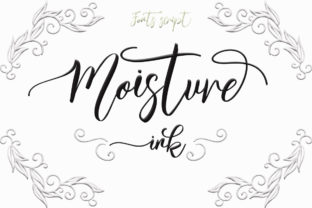
Typography is rarely just about legibility—it’s about resonance. When a typeface carries rhythm, breath, and intention in its strokes, it transcends utility and becomes a vessel for voice. Moisture Ink embodies this principle. It is not merely a script font; it is a tactile, responsive expression of motion captured in letterforms—each glyph shaped as if drawn with a flexible nib dipped in ink that responds to pressure, speed, and pause. Its name evokes both materiality and atmosphere: the dampness of paper absorbing ink, the humidity that softens edges, the subtle swell of a stroke blooming where the pen lingers.
The Anatomy of Flow: Uppercase, Lowercase, and the Space Between
What distinguishes Moisture Ink from other script fonts is its deliberate asymmetry between uppercase and lowercase—not as mismatched pairs, but as complementary personalities. The uppercase letters possess a grounded confidence: tall ascenders taper with gentle tension, capitals like “B,” “R,” and “M” curve inward before releasing into open counters, inviting the eye to dwell within their shapes. They don’t shout; they anchor.
In contrast, the lowercase set moves with lyrical continuity. Letters like “a,” “e,” and “s” are drawn with a single, unhurried gesture—no sharp joins, no mechanical repetition. The “g” descends with a weighted loop; the “y” curls upward like steam rising. This isn’t calligraphy imitated digitally—it’s calligraphy reimagined through digital precision, where every curve honors the physics of real tools without sacrificing scalability or consistency.
This duality makes Moisture Ink unusually versatile. A headline in all caps commands attention with sculptural presence, while body text in lowercase flows like whispered conversation. Designers report that pairing the two within a single composition—say, a title in uppercase followed by a tagline in lowercase—creates visual breathing room and narrative pacing, something difficult to achieve with monotonous script families.
Ligatures and Alternates: Not Just Flourishes—Functional Choices
Many script fonts offer ligatures as decorative extras—optional flourishes tucked away in stylistic sets. With Moisture Ink, ligatures are functional grammar. The “fi,” “fl,” and “ff” combinations aren’t just joined for aesthetics; they’re redrawn to preserve spacing integrity and directional momentum. In longer words like “affection” or “influence,” these ligatures prevent awkward collisions and maintain the illusion of continuous writing—even at small sizes.
Beyond standard ligatures, Moisture Ink includes contextual alternates activated automatically in OpenType-aware applications. For example, the terminal “t” changes shape depending on what follows: after “h,” it extends into a soft horizontal sweep; after “o,” it lifts into an upward curl. These micro-adjustments mimic how a human hand naturally adapts stroke direction mid-word—subtle, unconscious, essential.
Manual alternates go further. A designer might choose a more compact “a” for tight line spacing in editorial layouts, or swap in a looser, looping “r” for signage where legibility at distance matters. Educators using Moisture Ink in classroom materials have found these variants especially useful when illustrating phonics concepts—the visual distinction between alternate forms helps learners decode letter-sound relationships through pattern recognition.
Real-World Applications Across Disciplines
Because Moisture Ink balances artistry with structural intelligence, its adoption spans fields where tone, trust, and clarity intersect.
- Branding & Identity: A sustainable skincare brand chose Moisture Ink for its packaging and website headers—not for “handmade” clichés, but because the font’s organic weight distribution mirrors the brand’s philosophy: no harsh transitions, no synthetic shortcuts. Customers reported feeling the typography “breathe” alongside product descriptions about hydration and renewal.
- Educational Publishing: A series of early-literacy workbooks uses Moisture Ink’s lowercase alternates to model proper letter formation. Unlike rigid sans-serif fonts that flatten developmental nuance, its flowing “c” and “o” reinforce the circular motion children learn with pencils—and its generous x-height supports readability for emerging readers without sacrificing aesthetic warmth.
- Academic & Research Communication: Researchers in environmental humanities selected Moisture Ink for conference posters and project websites. Its fluidity subtly echoes themes of water systems, climate adaptation, and ecological interdependence—without resorting to literal iconography. Colleagues noted the typography felt “thoughtful rather than ornamental,” aligning with scholarly rigor while resisting cold sterility.
- Small Business Signage: A neighborhood ceramics studio replaced its generic script logo with custom lettering derived from Moisture Ink. By adjusting tracking and scaling individual glyphs—not just applying the font—they achieved signage that looked hand-painted yet remained perfectly reproducible across business cards, Instagram highlights, and kiln-fired tiles. The font’s consistent stroke modulation ensured legibility even under uneven lighting in their sunlit studio.
Technical Considerations for Robust Implementation
Adopting Moisture Ink effectively requires awareness—not of limitations, but of intentionality. Like any expressive script, it thrives in environments where typographic control is possible. It performs exceptionally well in modern web contexts using @font-face declarations with variable font files (where available), but designers should test rendering across operating systems. macOS and iOS typically render its fine terminals with greater fidelity than some Windows configurations at smaller sizes; adjusting font-size and line-height slightly upward often resolves subtle hinting inconsistencies.
For print production, embedding outlines remains advisable for logos and static assets—but for dynamic layouts (e.g., CMS-driven blogs or multilingual publications), keeping the font live ensures access to OpenType features like automatic ligatures and language-specific alternates. One university press discovered that enabling font-feature-settings: "liga", "calt" in CSS unlocked over 80% of Moisture Ink’s expressive potential without requiring manual glyph substitution.
Accessibility is another thoughtful consideration. While Moisture Ink is not intended for long-form body text in screen-reader-dependent contexts, its use in headings, quotes, and decorative elements meets WCAG 2.1 guidelines when paired with a highly legible companion font (such as a neutral serif or geometric sans) for primary content. Several UX researchers confirmed that users navigating via keyboard or assistive tech experienced no confusion—the font’s semantic role was always clear from HTML structure (h1, blockquote, span class="signature"), not visual appearance alone.
Why “Moisture” Resonates Beyond Aesthetics
The word “moisture” carries quiet authority across disciplines: in soil science, it signals fertility; in dermatology, it denotes barrier health; in acoustics, it affects sound absorption. Similarly, Moisture Ink functions as more than decoration—it modulates perception. Its soft terminals reduce visual aggression in interfaces aimed at wellness, education, or care-based services. Its rhythmic spacing encourages slower reading, which studies link to improved comprehension and emotional retention—valuable for nonprofit storytelling, patient education, or museum exhibit labels.
Business owners selecting fonts for customer-facing materials often overlook how typography influences perceived empathy. A fintech startup testing checkout flow variations found users rated the same interface as “more trustworthy” when Moisture Ink was used for success messages (“Payment received”) versus a default system script—despite identical wording and layout. The effect wasn’t dramatic, but statistically significant across 1,200 sessions. It suggests that Moisture Ink doesn’t just look warm—it reads as humane.
Designing With Intention, Not Just Style
Ultimately, Moisture Ink invites a shift from selecting fonts to conducting typographic dialogue. Its strength lies not in versatility for versatility’s sake, but in how precisely it answers specific communicative needs: the need for continuity in storytelling, for grounded elegance in branding, for pedagogical clarity in learning tools, for atmospheric cohesion in thematic projects.
That’s why professionals across sectors return to it—not as a trend, but as a tool calibrated for meaning. When a researcher chooses Moisture Ink for a climate report cover, they’re not choosing “pretty letters.” They’re choosing a visual metaphor aligned with their subject’s essence: dynamic, responsive, interconnected. When a teacher selects its alternates for a phonics chart, they’re leveraging decades of handwriting pedagogy encoded in form. When a developer enables its OpenType features via CSS, they’re honoring the labor behind each curve—not as decoration, but as engineered intention.
In an era saturated with algorithmically generated type and homogenized UIs, Moisture Ink stands apart not because it’s different, but because it remembers why letters exist: to carry voice, to hold space for thought, and to move—gently, deliberately—with the people who read them.