Gothenstone: Where Handwritten Authenticity Meets Modern Design
Typography is no longer just about legibility—it’s about resonance. In a digital landscape saturated with uniform sans-serifs and algorithmically optimized UI fonts, readers—and buyers—are quietly gravitating toward type that feels human. Not perfect. Not sterile. Alive. That’s where Gothenstone stands apart: not as another decorative script, but as a signature font built on organic rhythm, subtle variation, and quiet confidence. It doesn’t shout; it leans in. And that shift—from polished uniformity to intentional imperfection—isn’t a trend. It’s a recalibration of how we communicate value, warmth, and individuality through design.
What Makes Gothenstone More Than Just “Another Script Font”
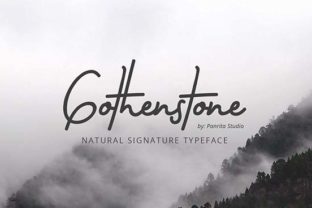
Gothenstone isn’t modeled after calligraphy tools or historical penmanship alone—it’s grounded in how real hands move: slight hesitations at curve transitions, gentle pressure shifts, and natural entry/exit strokes that mirror ink flowing across paper. Unlike many signature fonts that rely on heavy alternates or excessive ligatures to simulate authenticity, Gothenstone achieves its natural look through restrained, purposeful design. Its lowercase ‘a’, ‘g’, and ‘y’ carry soft, open forms—not rigidly stylized, but recognizably personal. The spacing breathes without feeling loose; the weight distribution suggests intention, not automation.
This isn’t merely aesthetic preference. Research in visual perception shows that viewers subconsciously associate irregular, hand-influenced letterforms with trustworthiness and approachability—qualities increasingly vital for brands operating in crowded, low-friction digital spaces. A wedding invitation set in Gothenstone doesn’t just announce an event; it signals care in curation. A small-batch coffee label using Gothenstone doesn’t just name a product—it implies craft behind the bean, the roast, and the story.
Why Now? The Quiet Rise of “Human-Centered Typography”
We’re seeing a broader cultural pivot away from hyper-optimized, AI-generated uniformity—and typography is mirroring that. Social media feeds, email newsletters, and even SaaS dashboards now routinely integrate handwritten-style elements—not as gimmicks, but as tonal anchors. This isn’t nostalgia. It’s responsiveness: users spend less time engaging with content that feels transactional and more time with what feels *authored*. That includes everything from the headline on a freelance portfolio site to the tagline on a limited-run T-shirt.
Gothenstone fits seamlessly into this shift because it was designed for versatility within authenticity. It scales cleanly from 14pt body text (in editorial layouts or greeting cards) to 120pt poster headlines without losing its tactile character. Its OpenType features include contextual alternates and swashes—but they’re subtle, not overwhelming. You don’t need design expertise to use them well. A marketer adding Gothenstone to a birthday e-invite can enable one alternate set and instantly elevate tone. A teacher designing classroom posters gains warmth without sacrificing clarity. No plugins, no tutorials—just intuitive refinement.
Real-World Use Cases—Beyond the Obvious
Yes, Gothenstone excels in wedding stationery and signature logos. But its practical utility extends further—especially where credibility and connection intersect:
- Small business branding: A local ceramicist uses Gothenstone for her logo and packaging labels—not to mimic handwriting, but to reinforce her hands-on process. Customers report feeling “more connected to the maker,” even before unboxing.
- Educational materials: An online course creator replaces generic headers with Gothenstone in downloadable workbooks. Learners cite improved retention—likely due to increased visual distinctiveness and emotional anchoring.
- Nonprofit storytelling: A climate initiative pairs Gothenstone headlines with clean sans-serif body text in annual reports. The contrast signals both humanity (the cause) and rigor (the data)—a balance hard to achieve with purely geometric fonts.
- Personal blogs & newsletters: Writers using Gothenstone for article titles see higher click-through rates on social shares—particularly among readers aged 35–50 who associate its texture with thoughtful, long-form content.
What ties these examples together isn’t novelty—it’s alignment. Gothenstone works because it supports intent, not overrides it. It doesn’t ask you to change your voice; it gives your voice a more resonant vehicle.
Designing With Intention—Not Just Decoration
Using Gothenstone effectively means resisting the temptation to overapply. Its strength lies in contrast: pair it with a neutral, highly legible sans-serif (like Inter, Lato, or even system fonts like SF Pro or Segoe UI) for body copy. Let Gothenstone handle moments of emphasis—headlines, quotes, monograms, short calls to action. Avoid stacking multiple decorative fonts; Gothenstone doesn’t need competition to hold attention.
Also consider context: on screen, use relative units (rem or em) and test at common viewport widths. Its natural stroke variation reads beautifully on high-DPI displays but may soften slightly on older mobile screens—so reserve it for larger display sizes in responsive layouts. For print, Gothenstone performs exceptionally well at standard resolutions (300 dpi), especially on textured papers where its organic edges harmonize with fiber grain.
And while Gothenstone is highly legible for short bursts, avoid extended paragraphs. Its charm is expressive, not exhaustive. Think of it like a well-placed accent color—not the entire palette.
Looking Ahead: Typography as a Signal of Values
As AI-generated visuals become ubiquitous, human-authored details gain new weight—not as relics, but as deliberate choices. Choosing Gothenstone isn’t about rejecting technology; it’s about curating where humanity shows up in your work. That matters to clients evaluating a designer’s sensibility. It matters to customers deciding whether a brand feels worth their loyalty. It matters to educators building inclusive, emotionally safe learning environments.
This isn’t about chasing “trendy” aesthetics. It’s about recognizing that typeface selection is one of the most accessible, immediate ways to signal care—in how you present ideas, represent people, or honor milestones. A birthday invitation set in Gothenstone tells guests, “You’re being thought of, individually.” A clothing tag printed in Gothenstone tells wearers, “This wasn’t mass-produced in abstraction—it was made with attention.”
That kind of quiet intentionality doesn’t require a big budget or technical overhaul. It starts with choosing a font that behaves like a collaborator—not a prop. Gothenstone doesn’t do the work for you, but it does make the work feel more grounded, more human, and more meaningfully yours.
Getting Started—Without Overcomplicating It
You don’t need a full brand audit to begin. Try this:
- Pick one recurring use case—e.g., email newsletter headers or Instagram Story text overlays.
- Replace your current display font with Gothenstone at the same size and weight.
- Compare engagement metrics over two weeks (open rates, completion rates, shares).
- Ask three trusted colleagues or customers: “What’s the first word that comes to mind when you see this headline?” Note patterns—not just “elegant” or “friendly,” but whether responses reflect your intended tone (e.g., “thoughtful,” “inviting,” “crafted”).
If the feedback aligns—and the metrics hold—you’ve found more than a font. You’ve found a consistent, scalable way to embed authenticity into your everyday communication. And in a world where attention is scarce and trust is earned slowly, that consistency compounds.