Nemophila: A Script Font with Refined Presence and Purposeful Personality
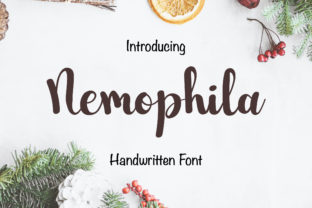
Nemophila is a script font designed to balance elegance with intention. It’s not merely decorative—it carries a quiet seriousness, a sense of grounded confidence that sets it apart from many contemporary script fonts. Its letterforms combine fluid connectivity with subtle structural discipline: strokes taper with control, terminals land with precision, and spacing avoids excessive looseness or tightness. The result is a typeface that feels both hand-crafted and carefully considered—ideal for designers seeking authenticity without sacrificing clarity or gravitas.
What Makes Nemophila Distinct in the Script Landscape
Most script fonts fall into one of two broad categories: highly casual, almost handwritten styles (think quick ink sketches or brush-lettered invitations), or formal, calligraphic revivals rooted in historical models. Nemophila occupies a deliberate middle ground. It retains the organic rhythm of connected lettering but introduces restrained contrast, consistent x-heights, and balanced weight distribution—traits more commonly associated with serif or sans-serif text faces.
This structural awareness gives Nemophila an unusual versatility. It reads well at moderate sizes—not just as a headline flourish, but as a supporting voice in branding systems, editorial layouts, or packaging where tone matters as much as legibility. Its lowercase a, g, and y feature closed, confident forms rather than open, airy loops, reinforcing its grounded character. Uppercase letters maintain presence without dominance, avoiding the theatrical flair that can overwhelm in extended use.
Where Nemophila Fits Among Alternatives
When evaluating script fonts for a project, designers often weigh three core considerations: personality alignment, functional range, and integration potential. Nemophila excels in the first two—but its third trait requires thoughtful assessment.
Compared to lighter, airier scripts like Quicksand Script or Lavanderia, Nemophila projects more authority and less whimsy. It’s better suited to a boutique law firm’s stationery than a summer farmers’ market flyer. Conversely, against highly ornate scripts such as Great Vibes or Parisienne, Nemophila feels less ceremonial and more contemporary—its curves are smoother, its baseline more stable, its rhythm less performative.
It also differs meaningfully from monoline scripts (those with uniform stroke width). While monoline fonts offer clean neutrality and high scalability, they often lack tonal depth. Nemophila’s gentle modulation—subtle thick-to-thin transitions—adds warmth and nuance without compromising readability. That said, this modulation means it doesn’t scale down as gracefully as a monoline option; below 18pt in body copy contexts, some details begin to soften, especially in lower-resolution outputs.
Strengths: When Nemophila Delivers Clear Value
Nemophila shines in applications where voice and visual cohesion matter more than sheer adaptability. It works especially well in:
- Brand identity systems seeking sophistication without austerity—think artisanal skincare, independent publishing houses, or curated retail spaces where craftsmanship and intention are central to the message;
- Editorial design for premium magazines or long-form digital features, where it anchors section headers or pull quotes with quiet distinction;
- Print collateral like letterpress business cards, engraved wedding invitations, or limited-edition book jackets—formats that benefit from its tactile sensibility and measured flow;
- Product labeling for goods positioned around heritage, authenticity, or slow-living values, where typography supports narrative rather than competes with it.
In each case, Nemophila contributes tone without demanding attention. It doesn’t shout; it invites closer reading. That restraint is a strength—not a limitation—when the goal is resonance over reaction.
Tradeoffs and Practical Considerations
No script font is universally appropriate, and Nemophila is no exception. Its strengths come with natural boundaries worth acknowledging upfront.
First, it’s not built for dense text. While it handles short bursts beautifully—taglines, signatures, chapter titles—it lacks the open counters, generous spacing, and optimized hinting needed for paragraphs or interface labels. Using it for UI elements, app navigation, or multi-line captions risks reduced scanability and inconsistent rendering across devices.
Second, its personality is specific. It conveys thoughtfulness, maturity, and care—but not playfulness, urgency, or informality. Pairing it with a bold geometric sans-serif (like Inter or Clash Grotesk) creates compelling contrast, but pairing it with another expressive script—or worse, a distressed display face—can dilute its impact and muddy hierarchy.
Third, language support varies. Most standard releases cover Latin-based languages thoroughly (including accented characters common in French, Spanish, and German), but extended Cyrillic, Greek, or Vietnamese glyphs may be absent unless explicitly included in the version you license. Always verify character coverage before committing to a project with multilingual requirements.
Decision Factors: Is Nemophila Right for Your Project?
Ask yourself these questions before selecting Nemophila:
- Does the project benefit from a calm, assured voice? If your brand or content leans toward reflection, craft, or timelessness—rather than speed, disruption, or trend-driven energy—Nemophila aligns naturally.
- Will it appear primarily in larger, intentional placements? Headlines, logos, signage, and short-form print materials suit it best. If you need a script that functions equally well at 12pt in a PDF report and 72pt on a billboard, consider a more engineered alternative.
- Is typographic harmony a priority? Nemophila pairs effectively with humanist sans-serifs (e.g., FF Meta, Harmony Sans) and low-contrast serifs (e.g., Freight Text, HTF Didot). Avoid clashing contrasts—such as ultra-bold grotesques or highly irregular display fonts—unless you’re deliberately pursuing dissonance as a concept.
- Do you have control over output quality? Its finer details hold up best in high-resolution print or modern web rendering. On older mobile browsers or heavily compressed JPEGs, some subtlety may be lost.
If most answers point “yes,” Nemophila is likely a strong candidate. If several point “no,” it may still serve a secondary role—perhaps as a logo lockup accent while a more neutral typeface handles body text—but shouldn’t anchor the system.
Realistic Use Cases in Context
A regional architecture studio uses Nemophila for its project names and client-facing reports—not for body copy, but for section dividers and signature blocks. Its measured curves echo the precision of their drawings, while its warmth softens the technicality of construction documents.
An independent literary press selects Nemophila for author name treatments on book spines and colophons. It complements traditional serif text faces without mimicking them, adding distinction without distraction—especially effective alongside Garamond or Adobe Caslon.
A ceramicist launching an online shop applies Nemophila sparingly: only on her “About” page banner and handmade product tags. It reinforces the handmade ethos without overwhelming product photography or competing with functional navigation.
In all cases, Nemophila isn’t used because it’s “pretty”—but because its particular kind of prettiness serves a purpose. It’s chosen deliberately, not decoratively.
Final Perspective: Choosing With Intention
Typography is never just about aesthetics—it’s about communication strategy made visible. Nemophila offers a rare combination: approachable elegance backed by structural integrity. It doesn’t try to be everything. It doesn’t chase trends. Instead, it provides a consistent, credible voice for projects where sincerity and substance carry weight.
That makes it worth considering—not as a default, but as a considered choice. When your goal is to signal care, continuity, and quiet confidence, Nemophila delivers with authenticity. When you need flexibility, neutrality, or high-functionality across formats, other options will serve you better. The key lies not in finding the “best” font, but the one whose character aligns with what your work stands for—and how you want people to feel when they encounter it.