Palmita: A Joyful Modern Calligraphy Font
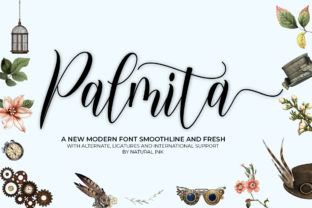
If you’ve ever struggled to find a script font that feels both elegant and alive—something that breathes personality into invitations, social posts, or handmade packaging—Palmita is worth your attention. It’s not just another decorative script; it’s a thoughtfully engineered calligraphy font designed for real-world versatility without sacrificing charm.
What Makes Palmita Stand Out?
At first glance, Palmita delivers an unmistakable romantic flow—bouncy baseline movement, soft curves, and rhythmic contrast between thick and thin strokes. But what sets it apart isn’t just aesthetics. Its flexibility comes from intentional design choices: generous spacing, open counters, and a natural hand-drawn rhythm that avoids stiffness or over-automation.
Unlike many scripts that look stunning in headlines but fall apart at smaller sizes or in body text, Palmita holds up across contexts—from 12pt product labels to 72pt wedding signage. That resilience stems from its balanced x-height, clear letterforms (like the unambiguous a, g, and l), and subtle but consistent stroke modulation.
Why PUA Encoding Matters (and Why You’ll Use It)
Palmita is PUA encoded—a technical detail with immediate practical impact. That means every swash, alternate glyph, and contextual ligature lives in a dedicated, predictable location in the font file. No hunting through obscure OpenType panels or guessing which key combination triggers a flourish.
You’ll access elegant entry swashes on capital letters, exit swashes on lowercase endings, and discretionary ligatures like “th”, “st”, and “ct” with simple keystrokes—or via your design app’s glyph panel. For creators using Adobe Illustrator, Affinity Designer, or even modern web tools like Figma (with variable font support), this translates directly to faster iteration and more expressive typography without extra plugins or workarounds.
Real-World Uses Across Creative Workflows
Wedding & Event Design Palmita shines where emotion and intention converge. Think hand-lettered-style save-the-dates with delicate ascenders looping into floral motifs, or acrylic table numbers where the font’s bounce adds lightness without visual noise. Its warmth reads as personal—not generic—and pairs effortlessly with minimalist layouts or textured backgrounds.
Digital Marketing & Social Content Brands aiming for approachable sophistication—think boutique skincare, independent bookshops, or ceramic studios—use Palmita for Instagram story headers, email subject lines, or limited-edition promo banners. Because it renders cleanly on screens and scales well across devices, it maintains legibility even when compressed or viewed on mobile.
Educational & Learning Materials Teachers and curriculum designers have adopted Palmita for printable worksheets, classroom posters, and digital flashcards—especially in early literacy or creative writing units. Its clear letter shapes support visual recognition, while its joyful tone reduces cognitive load for younger learners or neurodiverse audiences.
Product Packaging & Branding Small-batch makers use Palmita for jar labels, greeting cards, and subscription box inserts. Its flexibility allows for tight kerning on narrow spaces (like candle tins) or generous tracking for shelf-stopping hero text. When paired with a clean sans-serif secondary font—think Inter or Manrope—the contrast reinforces hierarchy without competing.
Practical Considerations Before You Commit
Like any high-character-count script, Palmita works best when used intentionally—not everywhere. Avoid setting full paragraphs in it. Reserve it for headlines, short quotes, logos, or accent text. Overuse dilutes impact and risks accessibility issues, especially for screen readers or low-vision users.
Also consider language support. Palmita covers Latin-based languages thoroughly (including accented characters for Spanish, French, Portuguese, and German), but doesn’t include Cyrillic, Arabic, or East Asian glyphs. If your project targets multilingual audiences beyond Western Europe and the Americas, verify coverage before finalizing.
File format matters too. The OTF version gives you full OpenType features—including stylistic alternates and contextual ligatures—in professional design apps. The web-optimized WOFF2 version delivers fast loading and crisp rendering—but may limit access to some advanced glyphs depending on your CSS setup. Always test live on your intended platform.
Pairing Palmita Thoughtfully
Its playful energy thrives alongside grounded, functional typefaces. Try pairing it with:
- Manrope or Inter for clean, neutral contrast in branding systems;
- Cormorant Garamond or Playfair Display for elevated serif pairings in editorial or luxury contexts;
- DM Sans or Space Grotesk if you want contemporary tension—soft script meets bold geometric sans.
Avoid pairing with other highly decorated scripts or fonts with competing rhythms. Two bouncy fonts create visual fatigue—not harmony.
Getting the Most From Palmita’s Features
Don’t skip the alternates. Palmita includes multiple versions of key letters—like a simplified g, a looped y, or a tapered t. These aren’t just decorative; they help solve real layout problems. Need tighter line spacing? Swap in a compact alternate. Want more airiness in a quote block? Use the extended swash version of h or k.
Ligatures do more than look pretty—they improve rhythm. The “fi” and “fl” ligatures prevent unsightly collisions. The “oo” and “ea” ligatures add subtle continuity in words like “moonlight” or “create.” Enable them by default in your OpenType settings, then disable selectively where needed.
And remember: Palmita isn’t meant to replace system fonts for UI or navigation. It’s a voice—not the whole conversation. Use it to signal warmth, care, and human touch where those qualities matter most.
A Final Note on Authenticity
In a landscape saturated with AI-generated fonts and mass-produced scripts, Palmita stands out because it was crafted—not computed. Every curve has intention. Every swash serves function before flourish. That authenticity resonates with audiences who value craftsmanship, whether they’re browsing your Etsy shop, reading your newsletter, or holding your wedding invitation in their hands.
It won’t solve every typographic challenge. But when you need to convey joy, tenderness, or quiet confidence—with clarity and grace—Palmita earns its place in your toolkit.