Beauty Nayshilla Duo: A Modern Font Pair Built for Clarity, Character, and Creative Control
Typography isn’t just about letters—it’s about voice, rhythm, and intention. When you choose a font pair, you’re not selecting two typefaces; you’re assembling a visual dialogue. That’s where the Beauty Nayshilla Duo stands out—not as a decorative afterthought, but as a thoughtfully engineered typographic system designed for real-world design needs.
More Than Just Two Fonts—A Cohesive Typographic System
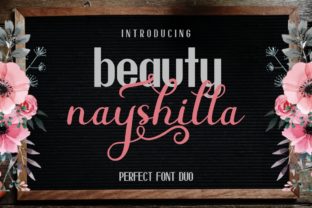
The Beauty Nayshilla Duo consists of two complementary styles: a refined, slightly condensed sans serif and an expressive, elegant script. Neither feels like an accessory to the other. Instead, they share subtle structural DNA—consistent x-heights, harmonized stroke contrast, and matching optical weight distribution—that allows them to lock into place visually without forced alignment or excessive tweaking.
This cohesion means designers spend less time adjusting letter-spacing or fiddling with baseline shifts—and more time communicating. Whether you’re designing a boutique skincare label, a wedding invitation suite, or a minimalist portfolio site, the Beauty Nayshilla Duo delivers instant typographic harmony. It’s not “safe” pairing—it’s intentional pairing.
Why Standalone Strength Matters Just as Much
What makes this duo especially versatile is that each style holds its own. The sans serif isn’t just the “neutral” counterpart—it carries quiet confidence. Its clean lines, gentle terminal flares, and balanced proportions give it presence in headlines, navigation bars, and even body text at larger sizes (think 18–24px on digital interfaces).
Meanwhile, the script doesn’t rely on the sans to justify its existence. It avoids over-the-top flourishes or fragile ligatures that break at smaller sizes. Instead, it offers graceful connectivity, consistent rhythm, and surprising legibility—even at 14px in email headers or product tags. That means you can use the script alone for a logo lockup or social media banner, and the sans alone for technical documentation or pricing tables—no compromise required.
Fitting Into Real Creative Workflows
Modern design isn’t siloed. A single project might span Instagram posts, Shopify product pages, printed packaging, and PDF lookbooks. The Beauty Nayshilla Duo was built with that reality in mind.
- Web-first compatibility: Both fonts include comprehensive OpenType features—including stylistic alternates, small caps, and localized numerals—optimized for variable font support and responsive rendering across browsers and devices.
- Cross-platform consistency: Whether you're exporting from Figma, Illustrator, or Adobe XD, the duo maintains spacing integrity and hinting accuracy. No more “that looks perfect on my screen but blurry on the client’s iPad” moments.
- Brand scalability: From micro-interactions (like hover states on CTA buttons) to large-format signage, the pair scales without losing nuance. Try the script in a subtle animated underline on a hero headline—the sans grounds it, the script lifts it.
Where It Shines: Industry-Specific Use Cases
You’ll find the Beauty Nayshilla Duo thriving in contexts where tone and trust go hand-in-hand.
In beauty and wellness branding, it bridges clinical precision and sensory warmth. Imagine a clean sans serif listing active ingredients beside a delicate script rendering the brand name—scientific credibility meets emotional resonance. No stock “luxury” clichés. Just clarity with charm.
For creative agencies and freelance designers, it’s become a go-to for client presentations where personality matters but professionalism can’t be compromised. One designer recently shared how she used the script for slide titles and the sans for speaker notes—“It made the deck feel human, not corporate.”
In digital publishing and editorial design, the duo supports hierarchy without shouting. A magazine feature might set pull quotes in the script (at 20pt, with generous line height), while body copy flows effortlessly in the sans at 16pt/1.6. Readers don’t notice the typography—they feel its pacing.
Practical Considerations Before You Commit
Even the most beautiful fonts need thoughtful implementation. Here’s what savvy users keep in mind when working with the Beauty Nayshilla Duo:
- Licensing scope: Check whether your intended use—especially if it includes app embedding, SaaS platforms, or merchandise—is covered. The standard web license covers up to 50,000 monthly pageviews; enterprise options exist for broader deployment.
- Language support: The duo includes full Latin-1 and Latin Extended-A character sets, covering Western, Central, and Eastern European languages. It supports diacritics for French, Spanish, Polish, Turkish, and more—but doesn’t extend to Cyrillic or Asian scripts.
- Weight flexibility: While the core duo ships in one primary weight per style (regular for sans, medium for script), many users combine them with lightweight system fallbacks (e.g., Inter or Manrope) for extended body copy—keeping the duo reserved for moments of emphasis.
- Accessibility note: The script is best used at larger sizes and with sufficient contrast (minimum 4.5:1 against background). For UI labels or form fields, lean on the sans exclusively—it’s WCAG AA compliant down to 14px.
Pairing Smartly—Beyond the Obvious
Yes, the Beauty Nayshilla Duo works beautifully together—but part of its strength lies in how it interacts with other typefaces. Think of it as a collaborative partner, not a closed ecosystem.
Try layering the sans serif with a geometric monospace (like JetBrains Mono) for tech-forward brands needing code snippets or data tables. The contrast feels intentional, not jarring. Or pair the script with a warm, low-contrast serif (such as Lora or Playfair Display) for literary projects—where the script adds movement and the serif lends authority.
One unexpected but effective combo? Using the Beauty Nayshilla sans as the sole font in a high-contrast dark mode interface, then introducing the script only in light-mode hero sections. It creates subtle context-aware personality—without sacrificing usability.
Why Designers Are Choosing It Over Generic Alternatives
There’s no shortage of “modern font duos” on marketplaces. So why does the Beauty Nayshilla Duo keep appearing in award-winning work and client-approved mockups?
Because it solves actual problems—not just aesthetic ones. It reduces decision fatigue during early-stage design sprints. It cuts revision rounds by delivering strong first drafts. And it gives non-design stakeholders something tangible to connect with: “That feels like *us*.”
Unlike many trend-driven pairs, it avoids overused traits—no faux-vintage ink traps, no exaggerated hairlines, no forced irregularity. Its elegance is earned, not applied. That restraint makes it age well. A website built with the Beauty Nayshilla Duo today won’t scream “2024” in three years—it’ll simply feel considered.
And perhaps most importantly: it respects the reader’s attention. In an era of infinite scroll and shrinking focus windows, typography that guides—not distracts—isn’t just nice to have. It’s essential.
A Final Thought on Intentional Typography
Fonts are tools—but great tools invite better work. The Beauty Nayshilla Duo doesn’t ask you to adapt your vision to fit its limits. Instead, it expands what’s possible within your existing workflow, your brand voice, and your audience’s expectations. It’s confident enough to stand alone, thoughtful enough to collaborate, and refined enough to disappear—just long enough for your message to land.
When your next project calls for typography that balances modernity with warmth, structure with soul, and efficiency with expression, the Beauty Nayshilla Duo isn’t just an option. It’s a quietly powerful choice—one that grows more valuable the more you use it.