Rollingstand: The Handwritten Font That Moves With Your Creative Momentum
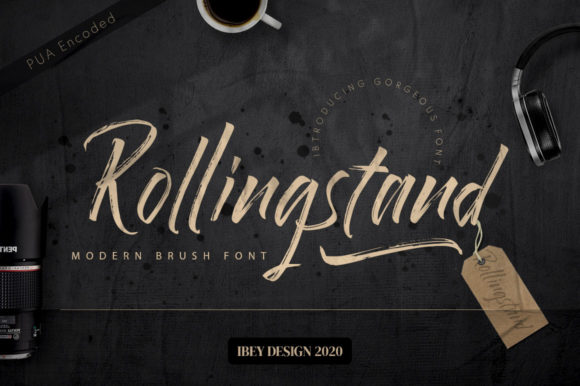
Imagine a font that doesn’t just sit still on the page—but breathes, flows, and feels alive. Not overly ornate, not artificially rigid, but authentically human: confident strokes with just the right amount of texture, rhythm, and spontaneity. That’s Rollingstand. It’s not another script font mimicking calligraphy from a century ago. It’s a modern handwritten typeface engineered for today’s creative pace—where speed, authenticity, and visual impact matter equally.
Why “Quick-Drying Strokes” Are More Than a Clever Phrase
The phrase “quick-drying strokes” isn’t poetic fluff—it’s functional design language. Rollingstand’s letterforms carry subtle tapering, natural entry/exit points, and intentional ink-weight variation—all hallmarks of a pen lifted swiftly off paper. That sense of motion translates directly into how viewers perceive your work: energetic, unforced, and refreshingly present.
This quality makes Rollingstand especially effective where immediacy matters. Think of a last-minute Instagram Story overlay for a pop-up event—no time to finesse layers or adjust kerning manually. Rollingstand delivers legibility and charm in one clean, intuitive set of glyphs. Its spacing is optimized so letters flow without crowding, even at small sizes. And because it avoids excessive flourishes, it scales beautifully—from a tiny product label to a full-wall mural.
Where Rollingstand Fits Naturally (and Why It Stands Out)
Not all handwritten fonts play well across contexts. Some feel too delicate for packaging; others overwhelm social posts with visual noise. Rollingstand bridges those gaps—not by being neutral, but by being adaptable.
- Photography & Watermarks: Its organic weight and open counters keep it readable over textured backgrounds or high-contrast imagery. Unlike thin scripts that vanish on busy shots, Rollingstand holds its ground—adding personality without obscuring the subject.
- Social Media & Ads: On feeds moving at lightning speed, Rollingstand’s rhythm catches the eye in under two seconds. Use it for short headlines, quote graphics, or CTA buttons—its warmth builds connection faster than sterile sans-serifs.
- Branding & Logos: For businesses leaning into artisanal, boutique, or lifestyle positioning—think craft coffee roasters, indie bookshops, or sustainable skincare lines—Rollingstand adds instant credibility. It signals care, craftsmanship, and approachability, all without shouting.
- Weddings & Invitations: Here, tone is everything. Rollingstand balances elegance and ease—never stiff, never sloppy. Pair it with a clean sans-serif for body text, and you’ve got a suite that feels personal, polished, and perfectly paced.
- Product Packaging & Labels: Whether it’s a small-batch hot sauce bottle or handmade candle jars, Rollingstand gives products tactile appeal—even in digital mockups. Its stroke consistency ensures laser engraving or foil stamping stays true to intent.
Real-World Workflow Wins
Creatives don’t choose fonts in a vacuum—they choose them based on what works *in practice*. Rollingstand was built with real tools and timelines in mind.
It includes full OpenType support—standard and discretionary ligatures, contextual alternates, and multilingual characters covering Latin-based languages (including extended diacritics for French, Spanish, German, and more). That means no scrambling to swap fonts mid-project when a client requests a bilingual menu or an international campaign.
Designers using Figma, Adobe Illustrator, or Affinity Designer report smooth performance—no lag during glyph substitution, no missing characters in export. And because Rollingstand’s default spacing is thoughtfully tuned, you spend less time adjusting tracking and more time refining concept and composition.
For marketers managing multiple campaigns, its versatility cuts down on font licensing complexity. One license covers web, desktop, app embedding, and even merchandise—so whether it’s a Shopify banner, an email header, or embroidered tote bags, you’re covered.
What Designers Notice First (and Keep Coming Back For)
When professionals test Rollingstand side-by-side with similar fonts, three things stand out almost immediately:
- Legibility at a glance: Even in low-resolution previews or fast-scrolling environments, characters like “a”, “e”, and “g” retain distinct shapes—no confusing loops or ambiguous terminals.
- Weight harmony: The Regular weight has enough presence for headlines, while the Light variant offers delicate contrast without frailty. No need to hunt for a separate “thin” companion font.
- Natural pairing potential: Rollingstand plays exceptionally well with contemporary sans-serifs—especially geometric ones like Poppins or neutral workhorses like Inter. The contrast feels intentional, not accidental.
One branding designer shared how she used Rollingstand for a local ceramics studio’s entire identity system: logo lockup, website headers, workshop handouts, and Instagram captions—all unified by that single, expressive voice. “Clients said it felt ‘like us before we even knew how to say it,’” she noted. That’s the quiet power of a well-designed handwritten font: it doesn’t shout identity—it reveals it.
Practical Considerations Before You Commit
Rollingstand isn’t magic—it’s a tool. And like any tool, its effectiveness depends on context and intention.
Ask yourself: Is your project aiming for playful whimsy—or timeless refinement? Rollingstand leans toward the latter. It’s joyful, yes—but grounded. If your brand thrives on cartoonish exuberance or ultra-minimalist austerity, this may not be your first pick.
Also consider scale. While Rollingstand performs admirably down to 14pt in UI or print, avoid using it for long-form body copy. Its strength lies in moments of emphasis—not endurance. Reserve it for headlines, quotes, labels, signatures, and short bursts of human-centered messaging.
Licensing is straightforward—but double-check usage rights if you’re building a SaaS platform or white-labeling templates for clients. Rollingstand’s standard license covers most commercial uses, but extended licenses are available for large-scale distribution or app integration.
Rollingstand in Action: A Few Smart Pairings
You don’t always need complex typography systems to make an impact. Sometimes, simplicity unlocks clarity—and Rollingstand shines brightest when paired intentionally.
- Rollingstand + Inter: Clean, friendly, and highly legible. Perfect for modern service brands—therapy practices, tutoring platforms, wellness studios.
- Rollingstand + Space Grotesk: A dynamic contrast—warm vs. structured, fluid vs. precise. Ideal for creative agencies or editorial projects with strong visual storytelling.
- Rollingstand + Lora (italic): Adds literary depth without formality. Great for book covers, poetry zines, or artisanal food branding.
And remember: sometimes the boldest move is restraint. Try using Rollingstand only for your logo and one recurring element—like section dividers or social media highlights. Let it anchor your visual voice, not drown it in repetition.
Final Thought: Fonts That Feel Human, Work Like Pros
In an age of AI-generated visuals and algorithm-driven feeds, authenticity isn’t a trend—it’s a threshold. Rollingstand meets that threshold with quiet confidence. It doesn’t try to be everything. It excels where handwritten expression matters most: in moments that invite attention, build trust, and feel unmistakably human.
Whether you’re designing a wedding suite at midnight, prepping a product launch for 500 customers, or refreshing a decade-old brand with fresh energy—Rollingstand moves with you. Not slowly. Not stiffly. But with the kind of quick-drying, sure-footed grace that turns deadlines into opportunities—and ideas into impressions that stick.