Sallsabila: Modern Calligraphy That Speaks With Quiet Confidence
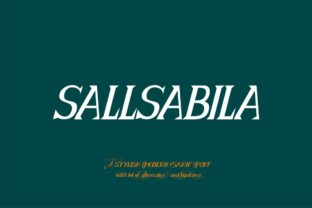
Imagine a font that doesn’t shout—but still commands attention. One that feels hand-drawn yet perfectly balanced, warm but never casual, elegant but never stiff. That’s Sallsabila: a new modern calligraphy font designed not just to look beautiful, but to carry meaning with clarity and calm authority.
What Makes Sallsabila Different From Other Calligraphy Fonts?
Most calligraphy fonts fall into two camps: either highly ornamental (think swirling flourishes and dramatic contrast) or overly simplified (thin, minimal strokes that lose personality). Sallsabila lives in the thoughtful middle ground. Its letterforms have gentle modulation—thicker downstrokes, softer transitions—but avoid excess decoration. There are no forced swashes or mandatory ligatures. Instead, it offers subtle rhythm, consistent spacing, and natural flow—like handwriting refined by intention, not algorithm.
It’s built for readability at real-world sizes: 16px body text holds up well in digital interfaces; 48px headlines feel grounded, not fragile. And because it’s carefully hinted and optimized, it renders cleanly across devices—from a designer’s high-res monitor to a client’s older Android phone.
Branding That Feels Human, Not Hyped
If you’re launching a wellness studio, an independent bookstore, a ceramicist’s online shop, or a boutique therapy practice, your brand voice likely leans toward sincerity, care, and quiet strength. Sallsabila supports that tone without leaning on clichés. Unlike script fonts that whisper “luxury spa” or “vintage bakery,” Sallsabila says, “We’re thoughtful. We mean what we say.” Try it on a business card, a website hero line (“Your first session starts with listening”), or even packaging labels—it adds warmth without sacrificing professionalism.
Digital Interfaces With Emotional Texture
Many UI designers default to neutral sans-serifs—even when the product is deeply personal. A meditation app, a journaling platform, or a family health portal benefits from typography that signals empathy. Sallsabila works beautifully as a display font for headings, onboarding screens, or microcopy like “You’ve got this” or “Let’s begin.” Paired with a clean, legible sans-serif for body text (like Inter or Manrope), it creates visual hierarchy *and* emotional resonance—no extra illustrations or stock photos needed.
Print That Stands Out Without Shouting
Wedding invitations, event posters, artisanal product tags, gallery exhibition titles—these materials live in physical space, where texture and intention matter. Sallsabila prints with satisfying weight and nuance on both matte and textured paper. Its moderate contrast means it won’t disappear on recycled kraft stock, and its open counters prevent ink spread on uncoated finishes. One graphic designer told us she used it for a local botanical garden’s seasonal workshop series—and attendees repeatedly commented on how “calm” and “inviting” the posters felt, even before reading a word.
Content Creators Who Want Personality—Without the Work
You don’t need to be a typographer to appreciate good type. Bloggers, newsletter writers, and small-business owners often struggle to find fonts that reflect their voice without requiring custom design work. Sallsabila is ready-to-use confidence. Drop it into Canva, Figma, or Adobe Express as a headline font, and suddenly your Instagram quote graphic or Substack banner feels intentional—not generic. It’s especially effective for short, resonant phrases: “Slow down,” “Made with care,” “This belongs to you.”
Who Benefits Most—and How They Use It Differently
- Freelance designers use Sallsabila as a reliable “tone-setter” font—deploying it across brand systems where clients want approachability *and* credibility (e.g., a financial advisor targeting Gen X women, or an eco-conscious skincare line).
- Small business owners appreciate that it installs and works instantly—no OpenType feature toggling, no fallback worries. One café owner replaced her old handwritten logo font with Sallsabila and noticed more customers pausing to read the chalkboard menu title (“Today’s Specials”) instead of scanning past it.
- Educators and therapists choose it for handouts, reflection worksheets, or welcome emails—because its soft geometry feels inclusive, not clinical. As one school counselor put it: “It doesn’t look like it’s judging the student—or the parent.”
Things to Keep in Mind Before You Use It
Sallsabila isn’t meant for long paragraphs. Its charm lies in brevity and emphasis—so reserve it for headlines, quotes, names, and short calls to action. For body copy, pair it intentionally with a highly legible, neutral sans-serif. Avoid pairing it with other decorative or high-contrast scripts; that creates visual competition, not harmony.
Also, consider context: while it performs well digitally, avoid using it at very small sizes (under 14px) in UI, especially on low-DPI screens. And if your project requires extensive multilingual support (e.g., extended Cyrillic or Arabic), check the character set—Sallsabila currently covers Latin-based languages thoroughly, with strong diacritic support, but isn’t built for broad global scripts.
Finally, remember that typography supports voice—it doesn’t replace it. Sallsabila will elevate sincere messaging, but it can’t compensate for vague copy or inconsistent branding. Use it where your words already carry weight—and let the font help them land with grace.
When Simplicity Actually Feels Like Strength
In a world saturated with bold claims, rapid motion, and aggressive aesthetics, there’s real power in restraint. Sallsabila doesn’t try to dazzle—it invites pause, encourages reading, and quietly affirms value. It’s the kind of font that makes a minimalist logo feel complete, a handwritten note feel intentional, or a digital interface feel like it was made *for people*, not just users.
Whether you're naming a new product, redesigning a portfolio, drafting a heartfelt email sequence, or choosing a font for your yoga studio’s next retreat flyer—ask yourself: does this need energy? Or does it need presence? If it’s the latter, Sallsabila is worth your attention.