BLAZE: A Bold Blackletter Font for Impactful Design
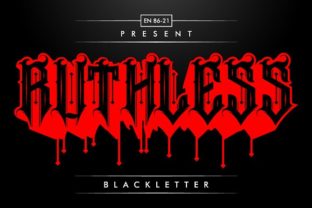
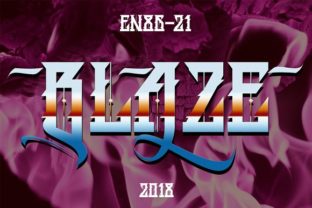
When your headline needs to stop scrolling, your logo needs to command attention, or your poster needs to echo the raw energy of vintage rock—BLAZE delivers with unmistakable presence. It’s not just another blackletter typeface. BLAZE is a carefully crafted interpretation of classic rock band logos: think tight kerning, sharp serifs, controlled irregularity, and an underlying rhythm that feels both deliberate and defiant. It doesn’t imitate—it distills.
Why BLAZE Stands Out in a Crowded Typeface Landscape
Most blackletter fonts fall into two camps: historically precise calligraphic revivals (often dense and hard to read at small sizes) or overly aggressive, decorative variants that sacrifice legibility for attitude. BLAZE occupies a rare middle ground: it retains the structural authority and visual weight of traditional blackletter while introducing subtle refinements—balanced stroke contrast, open counters, and consistent spacing—that make it far more versatile in real-world applications.
This balance matters because it means BLAZE works where many blackletter fonts don’t: on websites with responsive typography, in print layouts with mixed font families, and across branding systems that need both personality and professionalism. It’s designed to be *used*, not just admired.
Where BLAZE Adds Real Value—Not Just Style
For designers and small business owners building brand identity, BLAZE serves as a powerful anchor point. A coffee roaster launching a new single-origin line might use BLAZE for the bag’s main label—immediately signaling craftsmanship and bold flavor without needing explanatory copy. A music educator creating workshop posters can deploy BLAZE for the event title, evoking authenticity and tradition while keeping body text in a clean sans-serif for clarity. The contrast works *because* BLAZE doesn’t shout over everything else—it defines hierarchy with intention.
Marketers running social campaigns benefit from BLAZE’s instant recognition factor. On Instagram or TikTok thumbnails, where visual impact happens in under one second, a short phrase set in BLAZE—like “Live Session” or “Limited Drop”—cuts through algorithmic noise. Its strong verticals and compact width scale well even at reduced sizes, unlike many ornate blackletters that blur or collapse.
Practical Use Cases Across Roles
- Freelance designers use BLAZE as a go-to display font for album art, festival branding, or craft brewery labels—situations where clients want heritage cues without looking dated. Its OpenType features include stylistic alternates and ligatures that let you fine-tune tone: swap a sharper ‘R’ for grittier energy, or soften a ‘G’ for approachability.
- Educators and workshop facilitators apply BLAZE sparingly—to section headers in handouts or slide deck titles—to reinforce thematic focus (e.g., a unit on counterculture history or typography evolution). It signals importance without overwhelming learning content.
- Bloggers and content creators integrate BLAZE into custom graphics—not as body text, but as a signature element. One food writer uses it only for recipe names (“Smoked Paprika BLAZE Burger”), creating visual consistency across hundreds of posts while reinforcing her brand’s bold, hands-on ethos.
- Small publishers select BLAZE for limited-edition book covers—especially poetry collections, noir fiction, or zines—where typographic texture supports narrative mood without competing with cover imagery.
What BLAZE Is Not—and When to Pause Before Using It
BLAZE is intentionally high-contrast and structured. That makes it exceptional for headlines, logos, and short-form emphasis—but unsuitable for long paragraphs, data tables, or accessibility-critical interfaces. Its blackletter DNA means lower legibility at small sizes or low resolutions. If your audience includes readers with dyslexia or visual impairments, avoid using BLAZE for body copy or essential navigation labels. Always pair it with a highly readable companion font (a neutral sans-serif like Inter or a sturdy serif like Merriweather) and test contrast ratios.
It also carries strong cultural associations. While its rock-inspired roots lend authenticity to music, apparel, or artisanal brands, it may feel incongruous for healthcare, financial services, or academic institutions aiming for neutrality or trust through restraint. That’s not a flaw—it’s fidelity to its design intent. Choosing BLAZE is a deliberate stylistic decision, not a default.
Getting the Most From BLAZE: Smart Pairing and Implementation Tips
Start simple: use BLAZE at 36–60pt for headlines, 24–30pt for subheads, and never below 18pt unless tightly controlled (e.g., engraved-style caps on packaging). Kern manually when needed—its letterforms interact strongly, especially around combinations like “AV”, “To”, or “We”. The included spacing guidelines help, but screen rendering varies; preview on actual target devices.
Pair it thoughtfully. BLAZE gains strength from contrast: try it with a humanist sans-serif (like Lato or Poppins) for modern balance, or a warm, low-contrast serif (like PT Serif) for layered tradition. Avoid other decorative or high-contrast fonts nearby—they’ll compete rather than complement.
If you’re embedding BLAZE on a website, serve it as a variable font (if available) or subset characters to reduce load time. Prioritize WOFF2 format and define fallback stacks clearly. And always test loading behavior: a delayed BLAZE headline can undermine the very impact you’re seeking.
Who Benefits Most—and Why Timing Matters
BLAZE shines brightest for professionals who need to communicate attitude, authority, or authenticity *quickly*—and who have the creative control to use it intentionally. That includes indie filmmakers designing posters, podcast hosts crafting show logos, tattoo artists developing studio branding, and makers launching product lines with strong visual narratives.
It’s especially valuable during early-stage brand development, when establishing a distinctive voice matters more than broad flexibility. Once your core identity locks in, BLAZE becomes a reliable, repeatable asset—not a novelty.
That said, if your workflow relies heavily on template-driven tools (e.g., Canva’s free tier or basic email builders), BLAZE’s full potential may be limited by platform constraints. In those cases, consider whether investing in desktop design software—or commissioning custom adaptations—aligns with your long-term goals.
A Final Thought: Type as Tone, Not Just Text
Fonts are never neutral. They carry weight, history, and unspoken expectations. BLAZE doesn’t hide its lineage—it leans into it. But its refinement means it speaks clearly in contemporary contexts too. When you choose BLAZE, you’re not just selecting a font. You’re choosing a specific kind of confidence: grounded, expressive, and quietly assured. Used with purpose, it helps your message land—not because it’s loud, but because it’s unmistakably *yours*.