Ruthless: A Bold Blackletter Font for Striking Designs
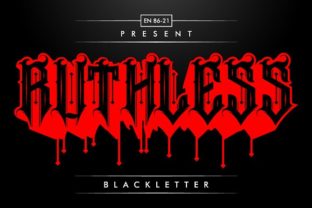
If you’ve ever seen a vintage metal album cover, a gritty tattoo sleeve, or a streetwear brand’s logo and felt that instant jolt of attitude—you’ve already felt the energy Ruthless brings to design. It’s not just another blackletter font. Ruthless is a carefully crafted typeface inspired by hand-drawn tattoos and raw, rebellious band logos from the ’80s and ’90s. Its sharp angles, uneven strokes, and aggressive rhythm give it an unmistakably intense, slightly ominous presence—without crossing into unreadability.
What Makes Ruthless Stand Out?
Unlike many blackletter fonts that lean heavily into historical calligraphy or religious manuscripts, Ruthless embraces imperfection as part of its personality. Letters have subtle inconsistencies—like ink bleeding at the edges or pressure shifts in a tattoo needle—that make it feel alive and human-made. It’s dense, high-contrast, and tightly spaced, which creates visual impact even at small sizes when used intentionally.
The “scary feel” isn’t about horror clichés—it’s about authenticity and edge. Think of it as the typographic equivalent of a well-worn leather jacket or a vintage amplifier cranked just loud enough to rattle the windows. That tone resonates with creators who want their work to communicate confidence, individuality, or intensity—not just decoration.
Who Benefits Most From Using Ruthless?
Ruthless works especially well for people who need to cut through digital noise. Bloggers launching a true-crime or occult-themed site might use it for headlines to set mood before readers even scroll. Small business owners running tattoo studios, record labels, or boutique apparel brands often choose Ruthless for logos, signage, or social media banners because it signals craftsmanship and character—not corporate polish.
Educators teaching graphic design or typography sometimes introduce Ruthless to spark conversations about tone, context, and audience perception. Freelancers building portfolios for edgy clients find it invaluable for title treatments on case studies or mockups. Even hobbyists designing custom posters for local concerts or zines appreciate how quickly Ruthless conveys genre and intention.
Real-World Uses You Can Try Today
- Logo design: Pair Ruthless with a clean sans-serif for body text (like Montserrat or Inter) to balance drama with clarity—ideal for breweries, underground music collectives, or alternative fashion labels.
- Digital headers: Use it sparingly in hero sections of websites or email newsletters where you want one strong emotional cue—just the headline, not paragraphs.
- Printed merch: Works powerfully on t-shirts, stickers, and vinyl record sleeves. Because of its bold weight, it holds up well in screen printing and embroidery.
- Social visuals: Instagram story covers, YouTube thumbnails, or Pinterest pins gain instant recognition when Ruthless anchors the message—especially for niche topics like folklore, dark academia, or retro gaming.
Practical Tips Before You Dive In
Ruthless shines brightest when used with restraint. Because it’s so expressive, overusing it—say, in full paragraphs or navigation menus—can fatigue readers and dilute its effect. Always test legibility across devices: while it reads clearly on desktops at 36pt+, smaller sizes (under 24pt) may blur details on mobile screens unless carefully kerned.
It’s also worth noting that blackletter fonts like Ruthless aren’t ideal for accessibility-first projects. Screen readers handle them fine, but users with dyslexia or low vision may struggle with dense letterforms. If readability is mission-critical—like in government forms or medical content—Ruthless is better suited for accents than core text.
Another gentle reminder: licensing matters. Ruthless is a commercial font, and while some versions are available for personal use, most professional applications require a proper license. Always check the source—whether you’re downloading from a foundry, marketplace, or designer’s portfolio—to ensure your usage aligns with the terms. Using unlicensed fonts can pose legal and branding risks, especially for businesses scaling up.
How Ruthless Fits Into Your Creative Toolkit
Think of Ruthless less as a “font to install and forget” and more as a deliberate design decision—like choosing a specific film stock or microphone for a recording. It adds texture, tells a story before a single word is read, and helps unify visual language across touchpoints.
For beginners, start simple: drop it into a Canva or Figma project as a headline font over a neutral background. Try pairing it with a soft, rounded sans-serif for contrast—this combo feels both grounded and daring. For pros, experiment with layering Ruthless in different opacities or blending modes to create depth in posters or web banners.
And remember: great typography isn’t about following trends—it’s about matching voice to vision. Ruthless won’t suit every brand or project, and that’s its strength. When it *does* fit, it doesn’t just sit on the page—it commands attention, invites interpretation, and leaves a mark.
A Final Thought on Intentional Design
Fonts like Ruthless remind us that type is never neutral. Every curve, angle, and spacing choice carries meaning—even if viewers can’t name why something “feels right.” Choosing Ruthless means leaning into boldness, honoring craft traditions (like tattoo artistry), and trusting your audience to connect with authenticity over polish.
Whether you're sketching a logo on paper, coding a landing page, or planning your next creative pivot—let Ruthless be the punctuation that says, “This matters. Pay attention.”