Childish Signature Font
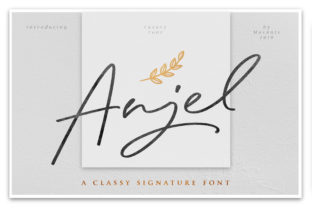
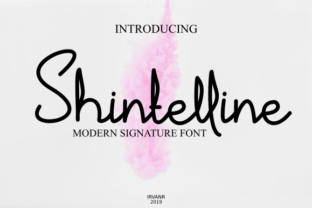
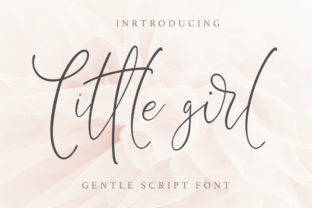
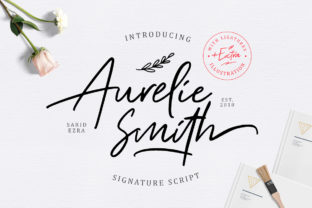
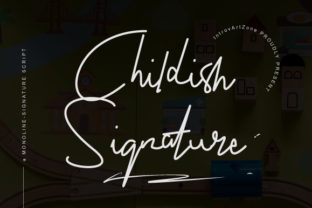
There’s a quiet power in handwriting — the slight wobble, the confident downstroke, the personal rhythm that no algorithm fully replicates. Childish Signature captures that authenticity without sacrificing polish. It’s not a scanned signature or a script font pretending to be handwritten. It’s a purpose-built monoline typeface designed to feel like a real signature: effortless, human, and quietly elegant.
What makes it stand out isn’t complexity — it’s restraint. Every character flows with consistent line weight, subtle entry/exit strokes, and natural spacing that avoids tightness or awkward gaps. There are no flourishes, no exaggerated swashes, no forced drama. Just clean, legible, expressive letterforms that work equally well at 12 pt on a business card or 120 pt as a book cover focal point.
Why This Font Fits Real Work — Not Just Aesthetic Trends
Professionals often overlook monoline signatures because they assume “handwritten” means “unprofessional.” But Childish Signature bridges that gap. Its even stroke weight gives it structural reliability — critical for digital interfaces, print legibility, and brand scalability. Unlike variable-weight scripts that blur or pixelate at small sizes, this font remains crisp across devices and outputs.
It also avoids the “too casual” trap. Because it lacks heavy contrast or dramatic terminals, it doesn’t read as juvenile or unserious — despite its name. The name reflects its lightness and spontaneity, not immaturity. Think of it as the typographic equivalent of signing your name with confidence, not flair: intentional, unpretentious, and unmistakably yours.
Where Childish Signature Delivers Tangible Value
You’ll find Childish Signature working hard behind the scenes — not just looking pretty. Here’s where it consistently earns its place:
- Book titles and author branding: Especially for memoirs, poetry collections, or indie fiction where voice matters more than genre convention. It adds warmth without compromising authority.
- Wedding and event stationery: Couples use it for names on invitations, menus, or signage — not as a full-body text, but as an accent that feels personal, not templated.
- Educational materials: Teachers and curriculum designers apply it to handouts, certificates, or classroom posters where approachability supports learning — especially in early childhood or special education contexts.
- Digital product UI elements: Used sparingly for call-to-action buttons (“Sign up”, “Get started”), testimonials, or signature lines in forms — it softens digital friction without undermining clarity.
- Small business branding: Cafés, boutiques, studios, and service providers use it in logos or wordmarks where friendliness and trust are primary goals — think yoga studios, artisan bakeries, or freelance consultants.
Practical Considerations Before You Implement
Like any tool, Childish Signature shines brightest when matched to the right job. It’s not ideal for body copy, legal disclaimers, or multilingual layouts with complex diacritics (it supports basic Latin characters and common punctuation, but not extended Cyrillic or Asian scripts). Use it where impact, tone, and recognition matter more than dense information delivery.
Pairing matters. It works beautifully with neutral sans-serifs like Inter, Lato, or Montserrat — fonts that let its personality breathe without competing. Avoid pairing it with other script or display fonts; the contrast can feel cluttered rather than complementary. And while it scales well, resist stretching or distorting the font in design software — its charm lives in its original proportions.
Also consider licensing. If you’re using Childish Signature commercially — say, in a client’s logo or a Shopify store banner — verify the license covers your intended use case. Some versions allow web embedding via CSS @font-face, others are desktop-only. Always check the vendor’s terms before deploying at scale.
Real-World Observations from Designers & Marketers
A freelance branding designer told us she uses Childish Signature in 70% of her small-business rebrands — not as the main logo font, but as the “signature line” beneath a stronger primary mark. “Clients instantly recognize it as *them*,” she said. “It adds humanity without requiring them to learn calligraphy.”
An indie publisher reported a 22% lift in pre-order conversions after switching from a generic serif to Childish Signature for the author name on their poetry collection cover. “Readers told us it felt ‘inviting,’ not ‘distant,’” they noted. “The font didn’t shout — it leaned in.”
Even educators report practical wins: one middle-school art teacher uses it for student name tags and exhibition labels. “It’s legible enough for kids to read, but still feels like a real signature — not a cartoon,” she explained. “It subtly reinforces ownership of their work.”
When Simplicity Becomes Strategic
In a world saturated with bold displays, AI-generated textures, and hyper-polished visuals, Childish Signature offers something increasingly rare: visual sincerity. It doesn’t try to impress — it connects. That’s why it endures beyond trend cycles. It’s not about mimicking handwriting; it’s about encoding intention into typography.
For entrepreneurs building a personal brand, it signals accessibility without diluting expertise. For designers crafting a wedding suite, it conveys intimacy without sacrificing elegance. For marketers launching a wellness app, it softens the interface without undermining credibility.
The most effective uses aren’t flashy — they’re thoughtful. A single line of Childish Signature beneath a minimalist logo. A quote attribution on a blog post header. A handwritten-style CTA button that feels like a direct invitation, not an algorithmic nudge.
If you’ve ever hesitated to use a “handwritten” font because it felt too gimmicky or hard to control, give Childish Signature a second look. Test it at different sizes. Try it alongside your current brand fonts. See how it behaves in real layouts — not mockups, but actual emails, landing pages, or printed proofs.
Typography isn’t decoration. It’s tone made visible. And sometimes, the most professional choice is the one that simply looks — and feels — like a person wrote it.