Gianetta
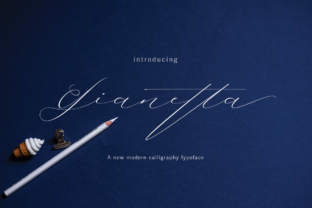
Gianetta is a modern calligraphy font designed to emulate the fluidity and expressiveness of hand-drawn lettering. Released by The Sully, it features natural stroke variation, subtle irregularities, and organic terminals—qualities that lend authenticity without sacrificing legibility or versatility. Unlike highly stylized script fonts that prioritize ornamentation over function, Gianetta balances artistic character with practical usability across digital and print contexts.
Why Consider Gianetta?
Designers and content creators often seek typefaces that convey warmth, personality, or elegance without appearing dated or overly formal. Gianetta appeals to those looking for a contemporary calligraphic voice—one that feels intentional but not rigid, refined but not sterile. Its appeal lies in its restrained expressiveness: it avoids excessive flourishes while preserving the human rhythm of handwritten forms.
People researching fonts like Gianetta typically fall into one of several categories: wedding stationery designers selecting an invitation typeface; small business owners crafting brand identities; bloggers or social media managers seeking cohesive visual tone; or marketers preparing promotional materials where tone and readability must coexist.
Key Benefits
Gianetta offers several functional advantages:
- Legibility at moderate sizes: Its open counters and consistent x-height support readability in body text applications such as blog headers or email subject lines—uncommon among script fonts.
- Cross-platform compatibility: Available in standard OpenType format, it renders reliably across major design tools (Adobe Creative Cloud, Figma, Canva) and web environments when properly embedded.
- Natural rhythm: Letter spacing and connecting strokes are carefully calibrated to avoid visual clutter, making it suitable for longer phrases—not just single words or monograms.
- Neutral warmth: It avoids strong cultural or historical associations (e.g., Victorian formality or Art Deco geometry), allowing it to adapt across industries—from wellness brands to boutique retail.
Tradeoffs and Considerations
No script font performs equally well in all contexts, and Gianetta is no exception. Its calligraphic nature means it is not intended for extended body copy. At small sizes (below 14px on screen or 8pt in print), detail loss may reduce clarity, particularly in lowercase 'a', 'g', or 's'. Kerning pairs are optimized but may require manual adjustment in dense layouts or tightly spaced headlines.
Additionally, Gianetta does not include stylistic alternates, swashes, or discretionary ligatures—features found in more elaborate script families. Users needing multiple weights (e.g., light, bold) or extensive language support beyond Latin-based scripts will find its character set limited. It supports basic Western European languages but lacks extended Cyrillic, Greek, or diacritical coverage common in global-facing projects.
Licensing is another practical factor. Gianetta is commercially licensed, meaning free use—especially in client work or distributed digital products—requires verification of appropriate permissions. Some users may assume “modern calligraphy” implies open-source availability, but The Sully distributes it under standard commercial terms.
When Gianetta Is a Strong Fit
Gianetta works best when the goal is to introduce subtle sophistication without overwhelming the message. It excels in contexts where tone matters as much as information:
- Invitations and announcements: Wedding, baby shower, or milestone event designs benefit from its graceful flow and personal feel—particularly when paired with clean sans-serif companions for supporting text.
- Brand signatures and logos: Small businesses using hand-crafted positioning (e.g., artisanal food, independent fashion, or creative services) find Gianetta conveys care and individuality without seeming contrived.
- Social media visuals: Its balanced weight and spacing hold up well in square or vertical formats, especially for quote graphics, story highlights, or profile bios where brevity and impact matter.
- Business cards and letterheads: When used selectively—for names, taglines, or section dividers—it adds distinction without compromising professionalism.
When Alternatives May Be Worth Exploring
Not every project benefits from a calligraphic approach. If your priority is high-contrast branding with strong visual hierarchy—such as tech startups emphasizing innovation or editorial publications requiring rigorous typography—Gianetta’s softness may dilute impact. In those cases, pairing a geometric sans-serif with a minimalist serif might better serve structural clarity.
Similarly, if multilingual support, variable font capabilities, or extensive OpenType features are required, alternatives like Playfair Display (for contrast-rich elegance) or DM Serif Display (for nuanced seriffed calligraphy) offer broader typographic flexibility. For users needing true handwriting variability—such as randomized glyph substitutions or contextual alternates—fonts like Brittany Signature or Qwigley provide more expressive range, albeit with reduced consistency.
Finally, budget constraints may steer some toward free or open-source options. While many free script fonts lack the refinement of Gianetta, resources like Google Fonts’ Dancing Script or Patrick Hand offer usable alternatives for low-stakes projects—though they often sacrifice spacing control, weight balance, or optical sizing.
Making a Practical Decision
To determine whether Gianetta aligns with your needs, begin by auditing your use case against three criteria:
- Function first: Does the font need to communicate quickly and clearly—or primarily evoke mood? If speed and scannability are critical (e.g., signage, app interfaces), Gianetta is unlikely to be optimal.
- Consistency vs. variation: Are you designing a system that requires predictable behavior across dozens of layouts? Gianetta’s strength is in controlled application—not systemic scalability.
- Technical environment: Will it be used in static PDFs, editable templates, or live web pages? Confirm rendering behavior in your target medium—especially if using fallback stacks or CSS
@font-facedeclarations.
Testing is essential. Download a trial version if available, and render real content—not placeholder text—at actual sizes and in intended contexts. Compare how Gianetta performs alongside your existing type system. Does it complement or compete? Does it clarify or complicate?
Ultimately, Gianetta serves a specific niche: thoughtful, human-centered communication where craftsmanship matters—but not at the expense of coherence. It is neither a universal solution nor a passing trend. Its value emerges most clearly when matched to goals that prioritize resonance over rigidity, and expression over excess.