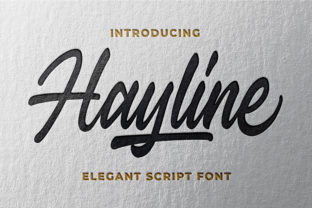
Hayline: A Charming & Bold Font Experience
Typography isn’t just about legibility—it’s about tone, intention, and presence. When your headline, logo, or social post needs to convey confidence without shouting, warmth without fading into the background, or distinction without sacrificing clarity, Hayline steps in with quiet authority. It’s not another neutral sans-serif or a decorative script meant only for invitations. Hayline delivers a charming and bold font experience that will turn any design idea into a true standout—because it balances personality with precision.
What Makes Hayline Different—Beyond Just “Nice Looking”
Hayline is a contemporary display typeface designed with strong, open letterforms, subtle contrast, and a humanist rhythm. Its uppercase letters carry weight and presence; its lowercase characters retain approachability and flow. Unlike many bold fonts that sacrifice readability at smaller sizes, Hayline maintains clarity even in tight spaces—like mobile banners, app buttons, or thumbnail text overlays. That duality—bold enough to command attention, yet refined enough to support sustained reading—is rare.
It’s also carefully spaced and kerned out of the box. That means less time adjusting letter pairs in Figma or Adobe Illustrator, and more time focusing on layout, messaging, or user experience. For professionals who juggle multiple tools and tight deadlines—freelancers building client websites, educators designing course slides, or small business owners updating Instagram graphics—this built-in polish translates directly into saved minutes per project. Over a month, those minutes add up to hours reclaimed.
Where Hayline Adds Real Value (Not Just Visual Flair)
Consider a freelance graphic designer preparing a brand identity package for a local bakery. The client wants something warm, artisanal, and trustworthy—not trendy or fleeting. Using Hayline for the logo mark and primary headings gives immediate character: the rounded terminals suggest friendliness, while the sturdy stems communicate reliability. Paired with a clean, modest sans-serif for body copy, the result feels intentional, not arbitrary. That kind of cohesion builds credibility fast—especially when presenting to non-design-savvy stakeholders.
Or imagine an educator creating a workshop handout on climate literacy. They need headers that feel grounded and authoritative—not clinical, not cartoonish. Hayline’s balanced stroke contrast and generous x-height make content feel both accessible and substantive. Learners scanning the page immediately grasp hierarchy, and the font’s warmth subtly lowers cognitive barriers—making complex topics feel more inviting to engage with.
Bloggers and content creators also benefit. A newsletter subject line set in Hayline stands out in crowded inboxes—not because it’s loud, but because it’s *distinctive*. Its charm lies in restraint: no exaggerated swashes, no forced quirks. That makes it versatile across platforms, from email clients to dark-mode interfaces, where over-stylized fonts often lose impact or legibility.
Who Benefits Most—and Why Timing Matters
Hayline shines brightest for creators who need to express voice quickly, consistently, and across formats. That includes:
- Small business owners launching a new product or rebranding—where every visual touchpoint must reflect values without requiring a full design team;
- Marketers producing campaign assets under deadline, especially for social-first or short-form video where first-second recognition is critical;
- Educators and trainers developing learning materials where clarity, hierarchy, and approachability directly affect comprehension;
- Freelance designers maintaining a cohesive, ownable style across client work without defaulting to overused fonts like Montserrat or Poppins.
It’s especially helpful when you’re iterating rapidly—say, testing three versions of a landing page headline. With Hayline, you’re not choosing between “readable” and “memorable.” You’re working within a single, well-considered system.
Practical Tips for Getting the Most From Hayline
Start simple. Use Hayline for one high-impact element—like a hero section headline, logo lockup, or featured quote—and pair it with a neutral, highly legible text font (e.g., Inter, Lato, or even Georgia for print). Avoid stacking multiple display fonts; Hayline’s strength is focus, not competition.
Pay attention to size and weight. Hayline’s Bold and ExtraBold weights hold up exceptionally well at larger sizes (36px+), but its Regular weight remains legible down to ~18px in headings—ideal for responsive web use. On screens with lower resolution, avoid ultra-thin variants unless used sparingly and at generous scale.
If you're embedding Hayline on a website, serve it efficiently. Host it locally or via a trusted font service, and limit the number of weights loaded—often two (Regular + Bold) are enough for 90% of use cases. This keeps performance high and avoids invisible loading delays that hurt engagement.
When to Consider Alternatives
Hayline excels as a display or heading font—but it’s not intended for long-form body text. If your project centers on dense articles, documentation, or multi-page reports, lean on a dedicated text face for paragraphs and reserve Hayline for titles, pull quotes, and callouts.
It also assumes a certain level of typographic awareness. Users completely new to font pairing may find its character initially harder to place than ultra-safe options. That’s not a flaw—it’s a signal that Hayline rewards thoughtful application. If you’re still building confidence in typography, study how it’s used in real-world contexts first: notice spacing, contrast, and context in award-winning branding or editorial layouts.
And while Hayline supports Latin-based languages comprehensively, check coverage if you regularly typeset in extended Cyrillic, Greek, or Vietnamese. Its current release focuses on core Western European languages—so global publishers or multilingual educators should verify glyph support before committing to large-scale use.
A Quiet Shift in How We Communicate Visually
In an era of algorithm-driven feeds and shrinking attention spans, standing out isn’t about volume—it’s about resonance. Hayline doesn’t shout. It invites. It balances boldness with grace, confidence with humility, distinction with clarity. That balance is why it works equally well for a handmade ceramics studio’s packaging and a university’s public health campaign.
More than aesthetics, it supports intentionality. When you choose Hayline, you’re signaling that what you’re saying matters—and that how it looks matters just as much. Not as decoration, but as meaning made visible.
For professionals who craft messages daily—whether through visuals, words, or experiences—Hayline offers a reliable, expressive tool that integrates seamlessly into existing workflows. It won’t solve strategic problems on its own. But paired with clear thinking and purposeful design, it helps ensure your ideas land—not just seen, but felt.