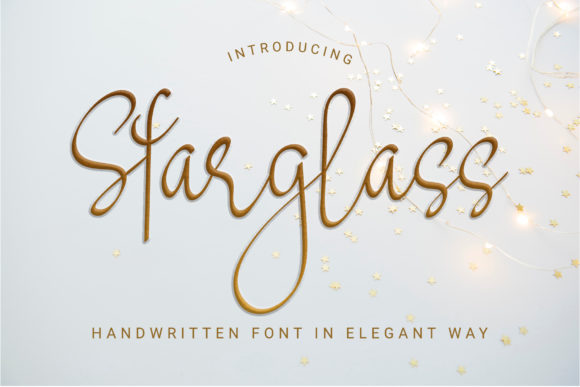
Starglass: A Sweet, Soft Script for Meaningful Design
Starglass isn’t just another script font—it’s a thoughtful tool shaped for warmth and intention. With its gently rounded, hand-lettered forms, it carries the quiet confidence of something handmade but polished enough for professional use. It’s the kind of typeface that invites pause: a greeting card that feels personal, a nature journal cover that breathes with organic rhythm, or a small-batch product label that signals care—not just craft.
What makes Starglass especially useful is how thoughtfully it’s built for real-world application. Its PUA (Private Use Area) encoding means every swash, alternate glyph, and contextual ligature is accessible directly from your keyboard—no complex OpenType panels required. That accessibility matters when you’re balancing creative work with deadlines, client revisions, or teaching a workshop on typography basics.
Where Starglass Fits Naturally
Because of its soft curves and open counters, Starglass excels where clarity and charm must coexist. It’s not suited for dense body text or technical interfaces—but it shines in contexts where voice and mood carry equal weight to information.
- Stationery & Print Collateral: Wedding invitations, thank-you notes, and boutique business cards gain sincerity with Starglass’s approachable elegance. Try pairing it with a clean sans-serif (like Inter or Lato) for headings and body copy—this contrast keeps hierarchy clear while letting Starglass anchor the emotional tone.
- Nature-Themed Art & Branding: Botanical illustrations, forest school logos, or eco-conscious packaging benefit from Starglass’s gentle rhythm. Its rounded terminals echo leaf veins, pebbles, and winding trails—not literally, but intuitively. One educator uses it for seasonal classroom posters (“Spring Seedlings,” “Winter Wonder Journal”) because students consistently describe them as “friendly” and “calm.”
- Digital Touchpoints: While web fonts require careful optimization, Starglass works well as a display font in SVG headers, email banners, or social media story templates. Export key phrases as lightweight vector graphics instead of embedding the full font file—this preserves fidelity without compromising load speed.
Getting More From the Glyphs
The real flexibility of Starglass lies in its layered features—not as decorative extras, but as functional choices. Alternate glyphs let you avoid repetition in short headlines (“Celebrate” can look distinct each time it appears). Swashes add subtle emphasis at word endings, not flourish for its own sake. And ligatures like “fi,” “fl,” or “st” improve spacing and flow without manual kerning.
Try this practical workflow: Type your phrase first using standard characters. Then, scan for repeated letters or awkward gaps—especially at the start or end of words. Swap in a swash only where it improves balance or guides the eye. Overuse dilutes impact; one well-placed entry or exit swash often does more than three scattered ones.
For Different Creators, Different Priorities
Freelancers & Small Business Owners: Use Starglass to unify visual identity across touchpoints without overdesigning. A single headline font paired with consistent color and photo treatment creates recognition faster than complex systems. For example, a ceramicist uses Starglass only for her studio name on packaging and Instagram highlights—keeping everything else minimal so the font becomes a quiet signature.
Educators & Content Creators: When designing handouts or digital worksheets, Starglass helps signal “this is for reflection” or “this is celebratory.” A homeschool parent prints weekly gratitude prompts in Starglass on pastel paper—students respond more openly than with sterile fonts. The key is restraint: reserve it for titles, quotes, or section dividers—not instructions or data tables.
Bloggers & Marketers: In crowded feeds, texture matters. Starglass adds tactile warmth to quote graphics or email subject lines (when rendered as images). But test legibility on mobile first—its softness can blur at very small sizes. Stick to 24px minimum for web display, and always pair with high-contrast backgrounds.
Keeping It Clear, Consistent, and Human
Starglass invites playfulness, but consistency keeps it trustworthy. Decide early: Will swashes appear only on initial caps? Will alternates be used only in logos? Document those choices—even informally—in a brand guide or project note. This prevents drift across platforms and saves time during revisions.
Also consider audience expectations. A financial advisor targeting retirees might find Starglass too light for formal reports—but perfect for a quarterly “What’s Growing This Season?” newsletter. Context shapes perception. Ask: *What feeling do I want this to evoke—and is that aligned with what the viewer needs right now?*
Finally, remember that originality comes from usage—not just selection. Two designers using Starglass will create vastly different results based on spacing, color, surrounding imagery, and purpose. One uses tight letter-spacing and deep navy for a vintage apothecary label; another opts for generous tracking and sage green for a mindfulness app splash screen. The font enables—the creator directs.
Simple Ways to Start Today
- Redesign one recurring item: Swap Starglass into your email signature line or blog post title template. Notice how it shifts tone—even slightly.
- Build a mini system: Combine Starglass with one free sans-serif and two complementary colors. Apply that trio to a social post, a printable, and a printed note. See how cohesion emerges naturally.
- Sketch before typing: Lightly pencil a short phrase, exaggerating roundness and flow. Then replicate that energy in Starglass—using alternates and swashes to echo your sketch’s rhythm.
Starglass doesn’t demand attention. It earns it—through warmth, consistency, and quiet precision. Whether you’re launching a new product, guiding a classroom, or simply making space for creativity in daily work, it offers a reliable way to communicate care through form. And in a world saturated with sharp edges and algorithmic polish, that kind of soft strength is increasingly rare—and increasingly valuable.