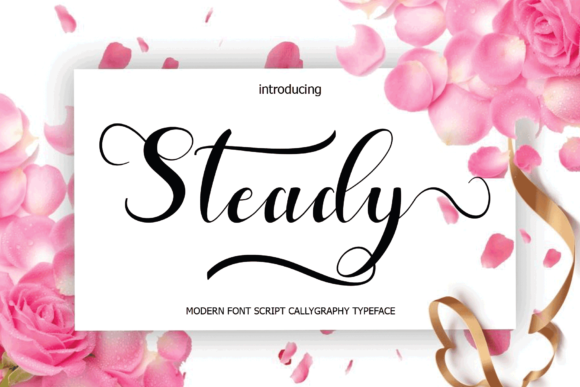
Steady
There’s a quiet confidence in typography that doesn’t shout—but still commands attention. Steady embodies that balance: sweet and romantic, yes, but also deeply elegant, composed, and intentional. It’s not just another script font designed for fleeting trends; it’s a carefully crafted typeface built for resonance—across mediums, audiences, and moments that matter.
Why Steady Stands Out in Today’s Visual Landscape
In an era saturated with bold sans-serifs, ultra-thin displays, and AI-generated letterforms, designers and brands are increasingly drawn to typefaces that feel human-made, emotionally grounded, and context-aware. Steady answers that need—not by rejecting modernity, but by refining it. Its curves are gentle but precise, its rhythm relaxed yet controlled, and its structure supports both intimacy and authority.
This isn’t accidental. As digital communication grows more transactional—think automated emails, templated social posts, algorithm-driven ads—the value of authenticity rises. A wedding invitation set in Steady feels personal because the letterforms carry subtle variation and warmth, not uniform perfection. A small-batch coffee brand’s logo using Steady conveys craft and care without leaning on clichéd rustic motifs. That duality—romantic *and* elegant, approachable *and* refined—is rare, and increasingly sought after.
How Design Workflows Are Shifting Toward Intentional Typography
Designers no longer treat fonts as static assets. With tools like Figma, Adobe Creative Cloud, and even modern web platforms supporting OpenType features natively, users expect—and can now easily access—rich typographic behavior: swashes, stylistic alternates, contextual ligatures, and discretionary glyphs. Steady is PUA encoded, meaning every special character, flourish, and alternate form is accessible without complex setup or coding. You don’t need a developer or plugin to unlock its expressive range—you simply select from your glyph panel or enable OpenType features in your design app.
This accessibility matters. Freelancers juggling five client projects benefit from a font that adapts quickly—from a minimalist business card (using clean base characters) to a layered, hand-lettered-style poster (activating swashes and ligatures). Educators crafting classroom materials can add visual interest to student handouts without sacrificing readability. Bloggers designing custom quote graphics find Steady’s elegance lifts tone without overwhelming content.
Real-World Applications That Highlight Its Versatility
- Wedding stationery: Steady’s romantic softness pairs naturally with ivory paper, dried florals, and delicate foil stamping—yet its structural clarity ensures names and dates remain legible at small sizes.
- Small business branding: A boutique skincare line uses Steady for its wordmark and product labels, balancing femininity with clinical trustworthiness—no competing fonts needed.
- Digital greetings: Animated e-cards or Instagram story templates gain tactile warmth when Steady replaces generic scripts, especially when alternate glyphs subtly shift letterforms across frames.
- Editorial accents: Magazines and newsletters use Steady sparingly—for pull quotes, section headers, or author bylines—to create contrast against neutral body text, guiding attention without disrupting flow.
The Evolution of Script Fonts—and Why Steady Fits Right In
Script fonts have long walked a tightrope between legibility and expression. Early digital scripts often sacrificed one for the other: some were too ornate for practical use; others were so simplified they lost all personality. The rise of variable fonts and better OpenType support has shifted expectations. Users now want flexibility *within* a single family—not just weight or width, but stylistic depth.
Steady reflects that evolution. Its alternate glyphs aren’t decorative afterthoughts; they’re thoughtfully paired to serve specific roles. An “a” with a higher entrance stroke might work better beside a tall “l”; a “t” with a tapered crossbar softens transitions in tightly spaced words. Ligatures like “fi”, “fl”, and “ct” resolve collisions gracefully—not just technically, but aesthetically. These details don’t show up in every use case, but they’re there when needed, supporting intention rather than imposing style.
What This Means for Professionals Who Rely on Visual Trust
For entrepreneurs launching a service-based business, typography is often the first nonverbal cue clients use to assess credibility and alignment. A font that feels too casual may undermine expertise; one that feels overly formal may distance potential customers. Steady bridges that gap—it signals competence through proportion and spacing, while inviting connection through warmth and flow.
Marketers building email campaigns notice how Steady improves open rates on subject lines that use its swash capitals—subtle enough to avoid spam filters, distinctive enough to stand out in crowded inboxes. Content creators repurposing blog posts into Pinterest graphics find Steady scales well across devices, retaining charm whether viewed on mobile or desktop.
Importantly, Steady avoids trend dependency. It doesn’t mimic calligraphy apps or lean into exaggerated bounce or irregular baselines—choices that date quickly. Instead, it draws from timeless principles of letterform harmony, making it resilient across platform updates, design tool iterations, and shifting aesthetic preferences.
Getting the Most From Steady—Practical Tips
- Start simple: Use base characters for body copy or short headlines before layering in swashes—let hierarchy guide where embellishment adds value.
- Test spacing early: Steady’s elegance relies partly on generous letter-spacing in display settings. Avoid auto-kerning overrides unless you’re adjusting for specific pairings.
- Leverage alternates contextually: Try swapping the default “g” for its alternate in words ending with “-ing” or “-age”—it often improves exit strokes and visual balance.
- Pair mindfully: Steady works beautifully with clean, neutral sans-serifs (like Inter, Lato, or Manrope) or low-contrast serifs (such as Literata or PT Serif). Avoid competing scripts or high-contrast fonts that clash tonally.
- Respect medium limits: On screens smaller than 16px, stick to base glyphs and disable swashes—clarity trumps ornamentation in UI or mobile contexts.
Typography as Quiet Strategy
Steady doesn’t promise viral virality or overnight brand recognition. What it offers is something more durable: consistency with character, professionalism with personality, and elegance that serves purpose—not just appearance. In a world where attention is fragmented and authenticity is scrutinized, choosing a font like Steady is a small but meaningful act of alignment—between what you make, who you serve, and how you want to be perceived.
It’s the kind of detail that goes unnoticed when it’s missing—but unmistakable when it’s present.