Vallencia Font
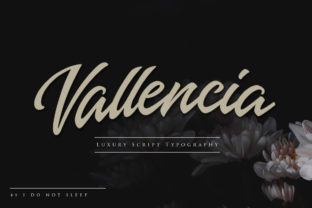
Vallencia is a script font designed with intention—neither overly ornate nor excessively restrained. It belongs to the modern script category, characterized by flowing letterforms that retain structural clarity. Unlike traditional calligraphic scripts that prioritize decorative flourishes, Vallencia emphasizes legibility without sacrificing elegance. Its letters are firm and neatly constructed, with consistent stroke contrast and balanced spacing. This makes it function well across both digital and print contexts, especially where readability and visual tone must coexist.
People often explore Vallencia when seeking a script typeface that bridges formality and approachability. Designers working on branding for lifestyle brands, boutique services, or creative agencies may consider it for logos, headings, or short-form editorial use. Educators, content creators, and small business owners evaluating fonts for newsletters, social graphics, or presentation decks also encounter Vallencia in font libraries and subscription platforms. Its appeal lies not in novelty alone, but in how its characteristics align—or don’t—with specific communication goals.
Why Vallencia Stands Out Among Script Fonts
Three qualities distinguish Vallencia in practical use: elegance without fragility, youthful energy without informality, and readability at moderate sizes. Many script fonts sacrifice legibility for flair—thin hairlines, tight letterfitting, or exaggerated joins can hinder comprehension, especially on screens or at smaller point sizes. Vallencia avoids those extremes. Its letterforms maintain open counters and generous x-height proportions, supporting quick character recognition. The rhythm of its lowercase alternates between gentle curves and purposeful angles, giving it presence without visual noise.
This balance makes Vallencia suitable for applications where tone matters as much as function. A wedding invitation benefits from its graceful flow; a tech startup’s “About Us” section might use it sparingly to soften otherwise clinical language. Because it scales predictably, designers can apply it confidently across responsive layouts—provided they pair it thoughtfully with a neutral sans serif or slab serif for body text.
When Vallencia Fits Well
Vallencia performs best in controlled typographic environments. Ideal use cases include:
- Logo design for businesses with refined, human-centered positioning—think artisanal food brands, wellness studios, or independent publishers;
- Editorial headlines in magazines or digital publications where visual hierarchy relies on contrast between expressive display type and functional body copy;
- Marketing assets such as email headers, Instagram story text overlays, or product packaging where brief, high-impact messaging is needed;
- Invitations and announcements where warmth and intentionality support the message’s emotional weight.
In each case, Vallencia works because it’s deployed selectively—not as a default system font, but as a deliberate voice. Its effectiveness depends less on technical capability and more on contextual awareness: using it where readers expect stylistic nuance, and where the surrounding design supports its role.
Limitations and Tradeoffs
No script font excels universally—and Vallencia is no exception. Its primary constraint is functional scope. It is not intended for long-form reading. Paragraphs set entirely in Vallencia will strain readers due to reduced character differentiation and slower scanning speed. Similarly, its performance suffers in low-resolution environments or when rendered at very small sizes (under 14px), where subtle stroke variations blur.
Another consideration is licensing. Vallencia is typically available through commercial font providers, meaning usage rights vary by platform and project type. Free versions—if available—are often limited to personal use or lack full character sets (e.g., missing diacritics, currency symbols, or OpenType features like ligatures or stylistic alternates). Designers integrating Vallencia into client work must verify license compatibility with distribution channels, including web embedding, app bundling, or merchandise printing.
Finally, cultural perception plays a quiet but real role. Script fonts carry implicit associations—often linked to tradition, femininity, or luxury. While Vallencia moderates these cues with its clean structure, audiences may still interpret its use subjectively. A financial institution aiming for authority and neutrality might find it too soft; a children’s brand might find it insufficiently playful. Awareness of audience expectations helps avoid misalignment between intent and reception.
Comparing Alternatives
Vallencia occupies a middle ground between highly formal scripts like Playfair Display Script and casual handwritten options like Brittany Signature. If your priority is maximum legibility in mixed-caps settings, a geometric script such as Grand Hotel offers tighter spacing and stronger baseline consistency. For multilingual support or extended language coverage, fonts like Sanchez or Amatic SC (with broader Unicode ranges) may be more practical—though they trade some of Vallencia’s polish for utility.
When evaluating alternatives, ask: Does the font support the languages I need? Does it include OpenType features that enhance typographic control (e.g., contextual alternates, swashes)? Is variable font support available for responsive weight or width adjustments? Vallencia currently lacks variable axes, so designers requiring dynamic scaling must rely on discrete weights or manual adjustments.
Making a Practical Decision
Before committing to Vallencia, test it in your actual workflow. Import it into your design tool and simulate real conditions: view it on mobile and desktop, check contrast against background colors, and assess how it pairs with your chosen body typeface. Try setting a short headline, a tagline, and a sentence of body copy side-by-side. Does the hierarchy feel natural? Does the script enhance meaning—or distract from it?
Also consider your team’s technical capacity. If developers will implement Vallencia on a website, confirm that the font provider offers reliable web font hosting and CSS loading options. If you’re using it in printed materials, request a PDF proof with embedded fonts to verify rendering fidelity.
Ultimately, Vallencia is worth choosing when its strengths directly serve your communication objective—not because it looks “cool,” but because its measured elegance, readable structure, and adaptable tone match what your audience needs to see and understand. It is a tool for precision, not decoration. Like any script font, its value emerges not in isolation, but in thoughtful combination and intentional application.