Ellouise: The Script Font That Makes Handcrafted Elegance Feel Effortless
If you’ve ever spent 20 minutes tweaking letter spacing in Canva just to make a wedding invitation feel “right,” or stared at a handmade greeting card wondering why the text looks stiff instead of soulful—Ellouise might be the quiet solution you didn’t know you needed. It’s not another overused calligraphy font with generic swirls. Ellouise is a unique and sophisticated script font designed with intention: real-world flow, subtle personality, and ligatures that don’t shout—they *breathe*.
What Makes Ellouise Stand Out (Without the Jargon)
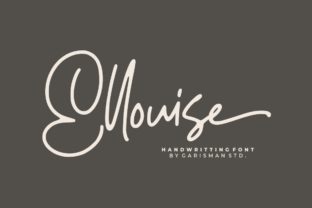
At its core, Ellouise is a connected script—letters join naturally, like fluent handwriting—but it avoids looking overly formal or fussy. Its lowercase ‘a’, ‘g’, and ‘y’ have gentle, open counters; its ascenders and descenders are graceful but never fragile. But what truly sets it apart is its ligature system: built-in alternate connections between common letter pairs (like “th”, “st”, “ff”, “ct”) that activate automatically in compatible software. These aren’t decorative flourishes added after the fact—they’re thoughtfully drawn, context-aware joins that mimic how ink flows from pen to paper.
That means when you type “celebrate” in Ellouise, the “ce” and “te” connect smoothly—not with a forced loop, but with a soft, organic curve. It’s the difference between something that looks *designed* and something that feels *lived-in*.
For Small Business Owners & Makers
Think of the local ceramicist who hand-paints mugs and needs a logo that reflects her tactile process—not sterile vector perfection. She uses Ellouise for her shop banner, packaging stamp, and Instagram story highlights. Because the ligatures work consistently across platforms (when embedded properly), her brand voice stays cohesive whether someone sees her name on a clay tag, a printed receipt, or a digital ad. No need to manually kern every word or swap in custom glyphs—Ellouise handles the rhythm so she can focus on glaze tests.
For Educators & Content Creators
A middle school art teacher uses Ellouise to design classroom posters with quotes about creativity. Why? Because students respond to warmth. A bold sans-serif feels authoritative; Ellouise feels inviting—like the teacher herself leaning in to explain. She also drops it into Google Slides for title slides on lessons about typography history, pairing it with a clean sans-serif body font to show contrast in function. It’s not “just pretty”—it’s a teaching tool that sparks conversation about how type carries tone.
For Wedding Planners & DIY Couples
One planner told us she keeps Ellouise pre-loaded in her template library for day-of stationery: place cards, menu prints, and ceremony programs. Clients love how it elevates simple kraft paper without feeling pretentious. And because Ellouise includes both standard and stylistic alternates (like a swash capital “E” or a tapered “t”), she can quickly adapt the same font for a romantic save-the-date email subject line *and* a minimalist table number sign—same family, different mood.
For Bloggers & Social Media Managers
Bloggers covering lifestyle, slow living, or mindful entrepreneurship often use Ellouise for featured quote graphics or newsletter headers. Not as body text—never—but as intentional punctuation: a single line of emphasis that stops the scroll. One freelance writer uses it only for her email signature line (“With care, — [Name]”) because it quietly reinforces her brand promise: thoughtful, human, unhurried.
What to Keep in Mind Before You Use Ellouise
Ellouise shines brightest when used with restraint—and awareness. It’s not built for long paragraphs, dense captions, or tiny mobile buttons. If you’re designing a product label with fine print, pair it with a highly legible sans-serif for the details and let Ellouise handle the brand name only.
Also: check your software. Ellouise’s ligatures work seamlessly in Adobe apps (Illustrator, InDesign, Photoshop), Affinity Suite, and modern versions of Microsoft Word and PowerPoint—but they may not activate in basic online editors unless OpenType features are explicitly enabled. If you’re using Canva, look for the “Font Features” toggle in the text panel; in Google Docs, you’ll need to install it locally and use it via the “More fonts” menu.
Licensing matters too. Ellouise is typically offered with a commercial license, but always verify the terms—especially if you’re embedding it in client websites, selling digital templates, or printing it on merchandise for resale. Some versions include web font files (.woff2); others are desktop-only. When in doubt, go straight to the foundry’s site rather than third-party marketplaces.
How Ellouise Solves Problems You Might Not Name Out Loud
Ever notice how many handmade brands default to the same three script fonts? It’s not laziness—it’s fatigue. Sourcing, testing, and licensing fonts eats time most creators don’t have. Ellouise cuts through that noise because it’s versatile enough to wear multiple hats: elegant but not fussy, distinctive but not distracting, detailed but not demanding.
It solves the “I want it to feel personal, but I’m not a calligrapher” problem. It answers the unspoken need behind “Make it look expensive—but keep my budget realistic.” And for educators or nonprofit staff juggling ten projects at once, it’s the rare font that delivers polish without requiring advanced typography knowledge.
One small press publisher uses Ellouise exclusively for poetry chapbook covers. Not because it’s “fancy,” but because its rhythm mirrors the cadence of spoken verse—soft pauses, natural lifts, space where breath belongs. Readers tell her the cover makes them *want* to read slowly. That’s not accidental. That’s Ellouise working as intended.
Getting Started—Without Overthinking It
You don’t need a design degree to benefit from Ellouise. Start simple: download a trial or free version (many foundries offer one weight with full ligatures). Open it in your most-used app. Type your name. Then type “thank you,” “handmade with care,” or “forever begins here.” Notice where the letters connect—and where they pause. Try changing the tracking slightly (+10 to +20) to give it air. Adjust size first, then weight, then color. Let the font guide you.
And remember: Ellouise isn’t about perfection. It’s about presence. It’s the quiet confidence of knowing your words land with grace—not because you mastered kerning, but because the typeface already understood the shape of sincerity.