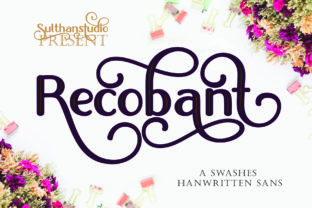
Anthology: A Handcrafted Sans Serif Font for Thoughtful Typography
Anthology is a handcrafted sans serif font designed with intention—not just aesthetics, but legibility, rhythm, and quiet confidence. It comes in two distinct styles: a clean, open-weight variant ideal for extended reading, and a slightly more structured, slightly bolder counterpart suited for headings and visual hierarchy. Neither feels mechanical nor overly stylized; instead, Anthology occupies a thoughtful middle ground between neutrality and character—where clarity meets craft.
What Makes Anthology Different From Other Sans Serifs
Many modern sans serifs prioritize uniformity: consistent stroke widths, geometric precision, and scalable neutrality. Anthology diverges by embracing subtle human variation. Its letterforms carry gentle irregularities—slight tapering in terminals, soft transitions between curves and straights, and carefully tuned spacing that breathes without calling attention to itself. These details aren’t decorative flourishes; they’re functional refinements that support readability at small sizes and add warmth at larger ones.
Unlike system fonts or widely licensed typefaces optimized for screen rendering above all else, Anthology was built with print and high-resolution digital use in mind—but without sacrificing on-screen performance. Its x-height is generous but not overwhelming, its counters are open but not exaggerated, and its lowercase ‘a’ and ‘g’ follow a single-story design that improves flow in body text without leaning into trend-driven minimalism.
Fitting Into Real-World Design Contexts
Anthology works especially well where tone matters as much as function: editorial layouts, brand identities that value authenticity over polish, academic publications seeking approachability, and long-form web content aiming for sustained reader engagement. It’s not a “default” font—and that’s part of its utility. When paired with a modest serif (like a warm-textured Garamond or a crisp, low-contrast Merriweather), Anthology creates contrast that feels intentional rather than arbitrary.
In practice, designers often choose Anthology when they need a sans that doesn’t compete with voice or imagery—something that supports rather than dominates. For example, a nonprofit publishing annual impact reports might use Anthology for body copy to convey sincerity and groundedness, reserving a restrained serif for pull quotes and section titles. A boutique studio building a website for a ceramicist might set product descriptions in Anthology’s lighter style, letting photography and texture take center stage.
Comparing Strengths and Tradeoffs
Anthology’s strength lies in its consistency across weights and its quiet adaptability—not in stylistic range. It does not include condensed, ultra-light, or display variants. That’s by design. If your project requires dramatic typographic contrast—say, bold editorial headlines stacked against delicate captions—Anthology may need thoughtful pairing, not standalone reliance.
It also lacks extensive language support out of the box. While it covers Latin-based Western European languages thoroughly (including accented characters used in French, Spanish, German, and Scandinavian languages), it doesn’t extend to Cyrillic, Greek, or extended diacritic sets common in multilingual publishing. That isn’t a flaw—it’s a boundary. Projects requiring broad linguistic coverage will need evaluation beyond Anthology alone, possibly supplementing with a compatible companion face.
Another practical consideration: Anthology is distributed as a desktop font family, typically licensed per user or per project. It’s not available through subscription-based font services like Adobe Fonts or Google Fonts. That means teams evaluating it must account for licensing logistics, installation workflows, and long-term file portability—especially if collaborating across platforms or handing off assets to third parties.
When Anthology Fits—and When It Might Not
Anthology is a strong candidate if you value craftsmanship over convenience, and if your use case benefits from a sans serif that avoids both cold uniformity and playful eccentricity. It shines in contexts where typography should recede just enough to let content breathe—yet remain perceptibly considered.
Consider Anthology when:
- You’re designing a publication or digital experience where tone, trust, and readability are primary goals;
- Your brand voice leans toward sincerity, intelligence, or understated refinement—not urgency, flash, or maximalism;
- You’re working with limited typographic inventory and need one sans that performs reliably across multiple sizes and mediums;
- You prefer fonts developed with physical drafting sensibilities—where spacing, weight distribution, and optical balance were tested on paper before screen.
It may be less suitable if:
- Your workflow depends heavily on cloud-based font syncing or real-time collaboration tools that don’t support custom font installation;
- You require fine-grained control over variable axes (like width, slant, or optical size) that Anthology doesn’t offer;
- Your audience spans many non-Latin scripts, and unified typographic treatment across languages is essential;
- You need rapid iteration across dozens of stylistic variations—for instance, A/B testing headline treatments across five weights and three widths.
How Anthology Compares With Broader Categories
Within the landscape of contemporary sans serifs, Anthology sits apart from both “neo-grotesques” (like Helvetica Neue or Inter) and “humanist” faces (like FF Meta or Syntax). It shares the structural honesty of the former but rejects their clinical austerity. It echoes the warmth of the latter but avoids calligraphic influence or overt stroke modulation.
Compared to popular free or open-source options, Anthology trades breadth for cohesion. Fonts like Roboto or Open Sans deliver wide language support, multiple weights, and responsive hinting—but often at the cost of distinctive rhythm or nuanced spacing. Anthology accepts narrower scope to deepen reliability within its intended range.
It also differs from “designer” fonts released as limited editions or experimental projects. Anthology isn’t meant to provoke or define a moment—it’s built to endure quietly, supporting communication across years, not seasons. That makes it less likely to feel dated, but also less likely to generate immediate visual excitement.
Practical Evaluation Tips
Before committing, test Anthology in your actual environment—not just a specimen page. Try it in your CMS editor, paste it into your email template, render it on the devices your audience uses most. Pay attention to how it behaves at 14px on a mid-tier laptop screen, or at 28px in a printed brochure.
Look closely at problematic characters: the lowercase ‘l’, uppercase ‘I’, and numeral ‘1’ should remain distinguishable without strain. Check how punctuation interacts—especially em dashes, quotation marks, and bullet points—in your line-height and column-width constraints.
If you’re comparing Anthology with alternatives, avoid judging solely on first impressions. Spend time with each font across multiple paragraphs—not just headlines. Read aloud. Notice where your eye stumbles or rests. Typography isn’t only about appearance; it’s about behavior over time.
Making the Choice With Confidence
Choosing a typeface isn’t about finding the “best” option—it’s about matching a tool to your specific context, constraints, and intentions. Anthology won’t solve every typographic challenge, nor is it meant to. But for designers, writers, and communicators who prioritize coherence, subtlety, and care in execution, it offers something increasingly rare: a sans serif that feels both deliberate and unobtrusive.
If your goal is to build trust through consistency—to let ideas land without distraction—Anthology deserves serious consideration. And if, after testing, it doesn’t quite align with your needs, that’s useful information too. The value isn’t in adopting Anthology, but in understanding why it does—or doesn’t—fit what you’re trying to do.